विवरण
EP Bevel Gear — European Standard Series | Ratio 1:3 | Pressure Angle 20°
Type A · Material: C45 Steel · Modules M1.5 to M5 · Miter & Right-Angle Power Transmission
1. Technical Specifications — Bevel Gear Ratio 1:3, Pressure Angle 20°, Type A
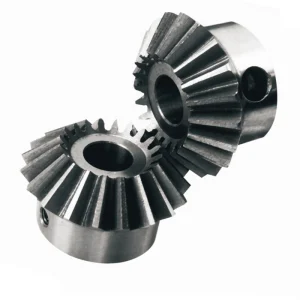
All dimensions are in millimetres (mm). The pinion (Z=16) and the wheel (Z=48) form a matched pair at ratio 1:3. Refer to the dimensional diagram for the definitions of De, Dp, A, F, Dn, D1, Dm, L, and Lm.
| M | जेड | De (mm) | Dp (mm) | ए (मिमी) | F (mm) | Dn (mm) | D1 (mm) | Dm (mm) | L (mm) | Lm (mm) |
|---|---|---|---|---|---|---|---|---|---|---|
| 1.5 | 16 | 26.9 | 24 | 22 | 12 | 20 | 10 | 46.3 | 21 | 9.7 |
| 48 | 72.9 | 72 | 22 | 12 | 42 | 15 | 29.2 | 19 | 12 | |
| 2 | 16 | 35.8 | 32 | 25.5 | 15 | 25 | 12 | 58.9 | 24 | 9.4 |
| 48 | 97.3 | 96 | 26 | 15 | 50 | 15 | 35.9 | 22 | 13 | |
| 2.5 | 16 | 44.7 | 40 | 28 | 18 | 33 | 14 | 70.4 | 26 | 9.2 |
| 48 | 121.6 | 120 | 32 | 18 | 60 | 20 | 44.6 | 27 | 16 | |
| 3 | 16 | 53.7 | 48 | 30 | 18 | 42 | 15 | 84.2 | 28 | 11.2 |
| 48 | 145.9 | 144 | 38 | 18 | 65 | 20 | 54.1 | 32 | 19 | |
| 3.5 | 16 | 62.6 | 56 | 36.5 | 22 | 48 | 15 | 98.8 | 34 | 13.4 |
| 48 | 170.2 | 168 | 44 | 22 | 75 | 20 | 62.5 | 37 | 23 | |
| 4 | 16 | 71.6 | 64 | 42 | 25 | 55 | 20 | 113.3 | 39 | 15.7 |
| 48 | 194.5 | 192 | 50 | 25 | 85 | 22 | 71.2 | 42 | 27 | |
| 4.5 | 16 | 80.6 | 72 | 53 | 28 | 60 | 20 | 133.4 | 50 | 23.4 |
| 48 | 218.8 | 216 | 58 | 28 | 90 | 25 | 81.9 | 49 | 27 | |
| 5 | 16 | 89.5 | 80 | 60 | 35 | 60 | 20 | 145.7 | 57 | 22.5 |
| 48 | 243.1 | 240 | 65 | 35 | 100 | 28 | 90.5 | 55 | 35 |
Note: M = Module; Z = Number of teeth; De = Outside diameter; Dp = Pitch diameter; A = Cone distance; F = Face width; Dn = Hub diameter; D1 = Bore diameter; Dm = Mean pitch diameter; L = Hub length; Lm = Mean cone distance. All dimensions in mm. Material: C45 Steel.
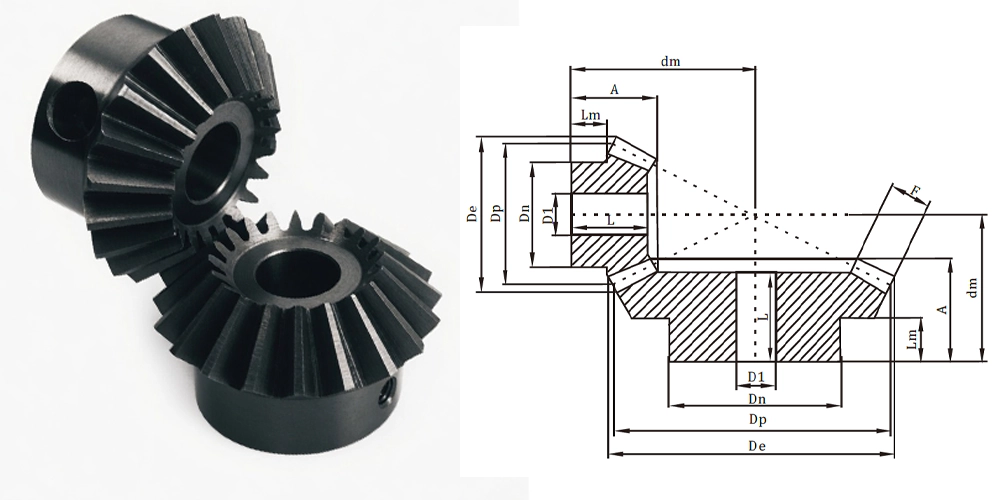
2. What Is a Bevel Gear?
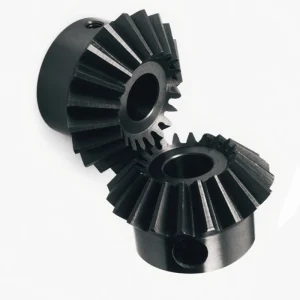
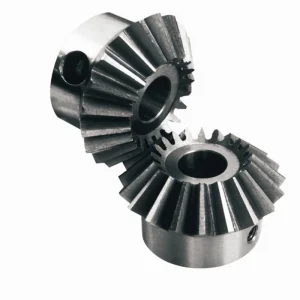
ए bevel gear is a cone-shaped mechanical component engineered to transmit rotational motion and torque between intersecting shafts — most commonly at a 90-degree angle. Unlike spur or helical gears that work on parallel shafts, this gear type changes the axis of rotation, making it indispensable wherever a direction shift is required within a drive train. The tooth profile is cut along the surface of a cone, and the pitch angle, pressure angle, and tooth geometry must all be precisely matched between the pinion (small gear) and the wheel (large gear) for smooth, quiet, and efficient operation.
This specific product — the EP Bevel Gear European Standard Series at a 1:3 ratio — is engineered to deliver a 3:1 speed reduction (or 1:3 speed increase, depending on configuration). With a 20° pressure angle and Type A geometry, these gears conform to widely recognised European dimensional standards, simplifying sourcing, replacement, and integration into existing European-standard machinery. Available in modules ranging from M1.5 through M5, the series accommodates an extensive range of torque and shaft-diameter requirements — from compact instrumentation assemblies to heavier-duty industrial drive systems.
3. How Does a Metal Bevel Gear Work?
The working principle of a metal bevel gear relies on the meshing of two conical gear bodies whose apex points converge at a single point on the axis of rotation. When the driving gear (pinion) rotates, its teeth engage sequentially with the teeth of the driven wheel, transferring torque smoothly across the angular interface. In a 1:3 ratio set, every full rotation of the pinion produces exactly one-third of a rotation in the wheel, resulting in a torque multiplication factor of approximately three — minus frictional losses. The 20° pressure angle used in this series optimises the balance between tooth strength and sliding friction: it is the international industry standard pressure angle for general-purpose power transmission, offering lower radial load on bearings compared to lower-angle alternatives while avoiding the heightened noise associated with higher angles.
The C45 medium-carbon steel construction allows the tooth flanks to be hardened selectively if required, improving wear resistance without making the core brittle. In practice, rotational input enters through the pinion shaft, the interlocking tooth geometry converts both speed and direction, and the output exits at 90° through the wheel shaft at one-third the input speed but three times the torque. This operating principle is why right-angle gear drives with a defined speed ratio remain the preferred solution in countless industrial, agricultural, and automotive applications.
4. Five Key Product Advantages
① European Standard Dimensional Accuracy
Every gear in this series is manufactured to European Standard geometry, ensuring that module pitch, pressure angle, and tooth proportions are interchangeable with equivalent components from other European-standard suppliers. This means maintenance teams can source replacement parts confidently, reducing machine downtime and inventory costs across industrial plants in Colombia, Spain, Germany, and beyond.
② Proven C45 Carbon Steel Construction
The use of C45 medium-carbon steel delivers an outstanding combination of machinability, tensile strength, and surface hardening potential. With a tensile strength typically in the range of 620–850 MPa after heat treatment, these heavy metal bevel gears resist pitting, spalling, and fatigue cracking under cyclic loading — characteristics that matter greatly in continuous-duty conveyor drives, mixer gearboxes, and industrial automation lines.
③ Versatile Module Range (M1.5 – M5)
Offering eight module sizes — from the compact M1.5 suitable for instrumentation and light conveying equipment up to the robust M5 used in heavy agricultural or industrial machinery — this series covers the widest practical range under a single product family. Engineers can specify the exact module that matches their torque and space requirements without redesigning supporting structures, keeping project timelines shorter and design costs manageable.
④ Consistent 1:3 Ratio for Predictable Torque Multiplication
The fixed 1:3 speed ratio provides a reliable, well-characterised torque multiplication of approximately 3× at the output shaft. This predictability is essential for system designers who need to size motors, select bearings, and calculate shaft stresses with confidence. A well-defined ratio like this eliminates guesswork from commissioning, particularly in food-processing lines, packaging machines, and agricultural equipment where consistent output speed directly affects product quality.
⑤ Type A Geometry for Compact Installation
The Type A profile used throughout this range is characterised by a straight-tooth bevel geometry that balances manufacturing cost with operational noise. Unlike spiral-cut variants — which offer quieter running but demand significantly more precise manufacturing and assembly — straight-tooth Type A units are robust, easy to align, and straightforward to replace in the field. This makes them the preferred custom bevel gears option for maintenance-intensive environments such as mining equipment, agricultural machinery, and general industrial drives operating in Latin American markets including Colombia, Peru, and Chile.
5. Material & Surface Treatment
The standard material for this entire European Standard gear series is C45 (1.0503) medium-carbon steel, which corresponds to AISI 1045 in North American nomenclature and S45C in Japanese JIS standards. C45 is selected for gear applications because it strikes the right balance between strength and workability: its carbon content of approximately 0.42–0.50% allows sufficient hardenability through flame hardening, induction hardening, or through-hardening processes, while the relatively low alloy content keeps raw material costs predictable.
In the as-supplied condition, C45 steel has a hardness of roughly 170–210 HB, which provides adequate wear resistance for light-to-medium duty cycles. For applications demanding longer service life or higher surface contact stress — such as continuous-duty conveyor drives or gearboxes in Colombian mining operations — the tooth flanks can be induction-hardened to 45–55 HRC without requiring a different gear blank. This flexibility makes C45 a cost-effective material choice across a very broad range of duty requirements. All gear surfaces are precision-machined, and finished bores are held to H7 tolerance to ensure consistent shaft fit across replacement parts.
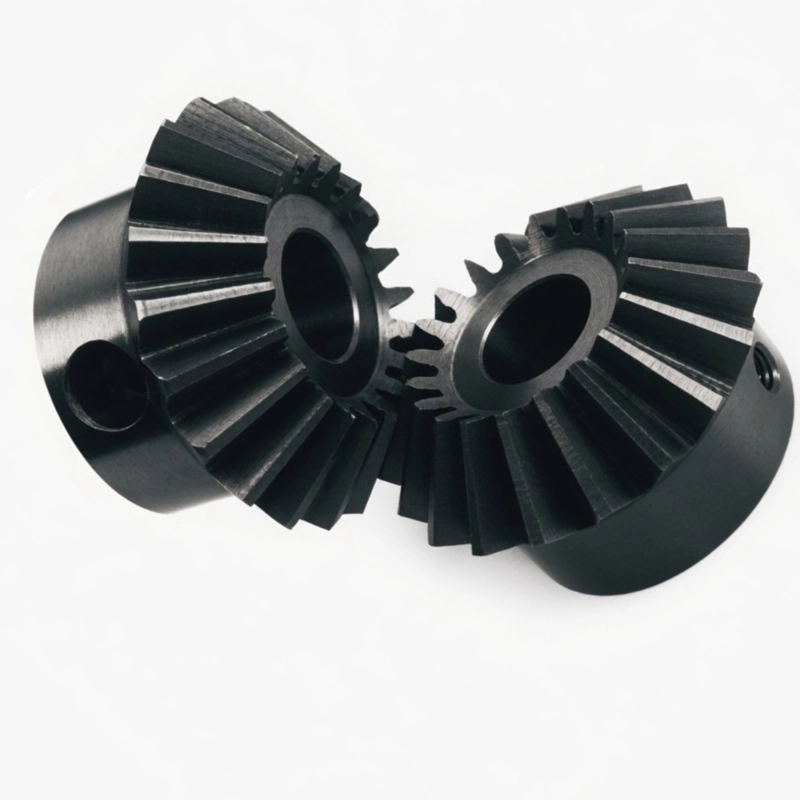
6. Metal Bevel Gear Application Scenarios
The versatility of these components in industrial and commercial machinery is hard to overstate. Below are the most common sectors where this 1:3 ratio European Standard metal bevel gear series finds deployment — from compact automation cells to large-scale agricultural and mining equipment widely used across Colombia and the broader Latin American region.
कृषि मशीनरी
From grain augers and forage harvesters to seed drills and irrigation pump drives, the right-angle torque transmission of a bevel gear set is fundamental in Colombian and Andean agricultural operations. The 1:3 ratio reduces the high-speed output of compact motors or PTO shafts to the slower, higher-torque speeds required by mixing drums, threshing cylinders, and cutter bars. C45 construction handles the shock loading typical of harvesting operations reliably over extended field seasons.
Industrial Conveyor & Packaging Lines
High-volume packaging plants, bottling facilities, and palletising lines throughout Colombia and other Latin American manufacturing hubs rely on compact small metal bevel gears in modules M1.5 to M2.5 for indexing tables, turning stations, and cross-conveyor transfers. The compact Type A profile allows these components to be integrated into tight machine frames where space is at a premium, while the European standard dimensions guarantee easy like-for-like replacement during scheduled maintenance stops.
Mining & Heavy Extraction Equipment
Colombia’s mining sector — extracting coal, gold, and emeralds — demands drive components that can handle intermittent overloads, dusty environments, and limited maintenance access. The larger modules (M4 to M5) in this series, with their substantial face widths and generous bore diameters, are well-suited to conveyor head-drive gearboxes, vibrating screen drives, and winch mechanisms where the combination of high torque and directional change is a regular requirement. High power metal bevel gears in M5 can accommodate bore diameters up to 28–35 mm depending on the tooth count.
Food & Beverage Processing
Mixers, dough kneaders, filling machines, and conveyor sorting systems in the food and beverage industry require reliable direction changes and consistent speed ratios. The 1:3 gear ratio is particularly useful for blending and mixing applications where the motor runs at relatively high speed while the mixing paddles or agitator blades need lower, controlled rotational speeds. C45 gear blanks can be combined with food-grade lubricants to meet hygiene requirements in Colombian INVIMA-regulated food processing facilities.
Automation & Robotics
Mini metal bevel gears in module M1.5 and M2 are increasingly specified in robotic joints, linear actuators, and pick-and-place automation cells where compact footprint and precise torque transmission are essential. The well-defined European Standard geometry of this series makes it straightforward to integrate into CAD designs and bill-of-materials databases. Industrial automation deployments across Bogotá, Medellín, and Cali’s growing manufacturing corridors are typical use-cases for this product.
Construction & Material-Handling Equipment
Concrete mixers, hoists, crane slewing drives, and portable compactors all rely on conical gear pairs to redirect power through tight geometric constraints. The larger modules in this range — particularly M4 and M4.5 — offer the load capacity needed for intermittent-duty construction applications, while the standardised European dimensions simplify procurement for project sites in Colombia, Ecuador, and Peru, where access to specialist tooling is often limited. This metal bevel gear application type is typically paired with roller chain drives for the final power delivery stage.
7. नियामक अनुपालन और उद्योग मानक
Mechanical power transmission components — including metal bevel gear parts — are subject to a layered framework of national and international standards that govern design, quality, and installation. Understanding this regulatory landscape is important for procurement managers and maintenance engineers in Colombia and across Latin America, as well as for any customer sourcing components for export into the European Union or North America.
International Standards (ISO): ISO 23509 defines the geometry of bevel and hypoid gears, while ISO 1328-1 establishes gear accuracy grades for cylindrical gears and provides a reference framework broadly applied to this gear category as well. ISO 6336 covers load-carrying capacity calculations — a prerequisite for any formal gear selection exercise. The European Standard geometry used in this product series aligns with these ISO benchmarks, ensuring that technical drawings and dimensional data are universally interpretable by engineers worldwide.
European Union (EU/CE): Machinery that incorporates right-angle gear drives and is sold into the EU market must comply with the EU Machinery Directive 2006/42/EC (and its successor regulation), which mandates a safety assessment, technical file, and CE marking. Gears themselves are mechanical sub-assemblies and are not independently CE-marked, but their installation within a machine forms part of the overall conformity assessment. DIN 868 (German standards for gears) and relevant EN ISO standards are the primary technical references used by European machine builders.
संयुक्त राज्य अमेरिका: The American Gear Manufacturers Association (AGMA) publishes standards such as AGMA 2003 for rating gear capacity. Although this product uses European Standard dimensions rather than AGMA dimensions, these standards remain relevant for load-rating calculations when the components are used in machinery targeted at North American markets.
Colombia (ICONTEC / NTC): In Colombia, the Instituto Colombiano de Normas Técnicas y Certificación (ICONTEC) adopts and publishes NTC (Norma Técnica Colombiana) standards, many of which are direct adoptions of ISO standards. Mechanical power transmission equipment destined for regulated industries (mining, food processing, pharmaceuticals) in Colombia may also be subject to sector-specific regulations issued by the Ministerio de Minas y Energía or INVIMA (food-contact applications). Importers should verify applicable NTC standards at the time of procurement.
Latin America (Regional): Brazil’s ABNT (Associação Brasileira de Normas Técnicas), Argentina’s IRAM, and Peru’s INACAL each maintain national standards largely harmonised with ISO. Products meeting ISO dimensional and quality specifications will generally satisfy the technical requirements of these national bodies. The Mercosur automotive and agricultural machinery sectors additionally reference Mercosur Technical Regulations (RTM) that may apply to gear-containing assemblies.
8. हमारे बारे में
We are a specialist manufacturer and global supplier of mechanical power transmission components with decades of experience supplying engineers, OEM manufacturers, and maintenance operations across more than 60 countries. Our product range spans bevel gear sets, spur gears, helical gears, roller chains, sprockets, and associated drive components — all manufactured to internationally recognised dimensional standards including European, ANSI/ASME, and JIS series.
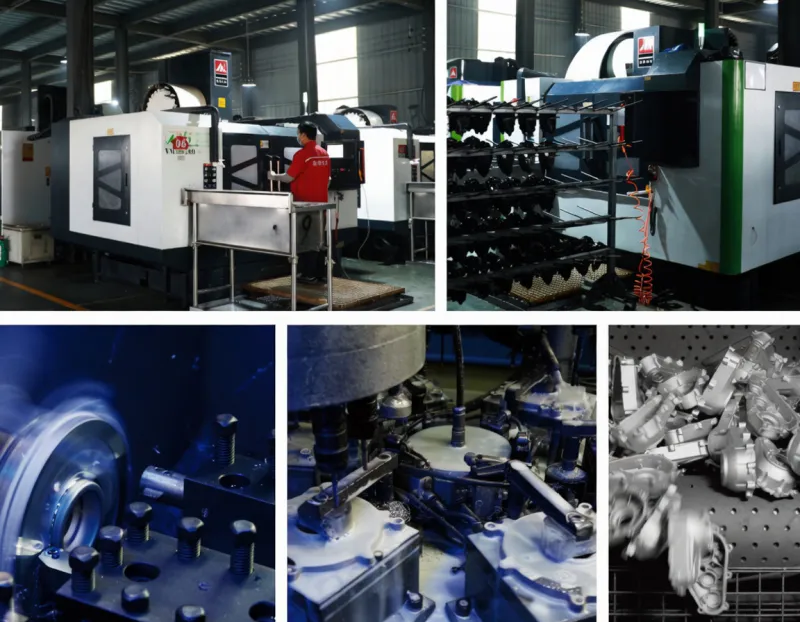
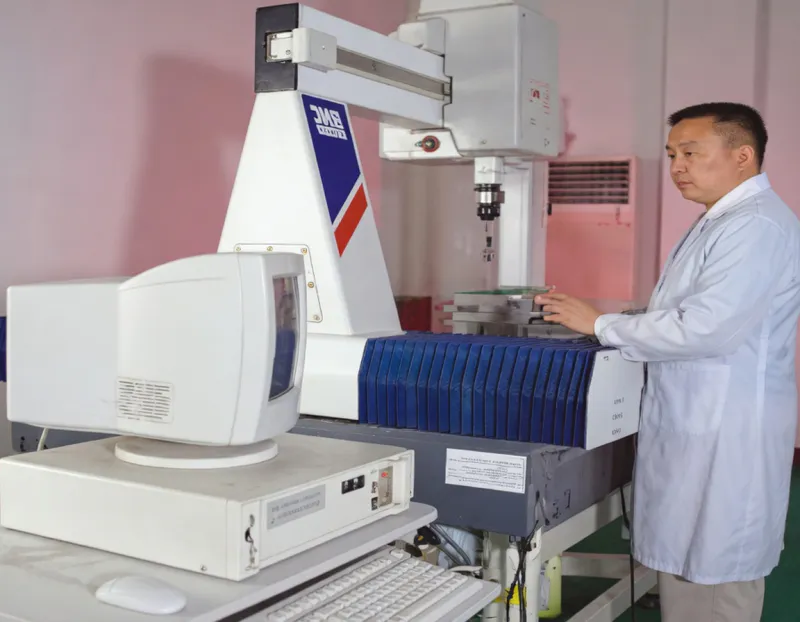
Our engineering team works directly with customers to identify the right module, material, and tooth geometry for each application. Whether you need standard catalogue items dispatched within short lead times or custom bevel gears machined to your drawings, we have the manufacturing capabilities and quality systems to deliver. Our ISO-certified production processes include CNC gear hobbing, gear shaping, heat treatment, and precision grinding — ensuring that every component leaves our facility meeting the dimensional and quality standards your application demands.
Customers in Colombia, Mexico, Chile, Peru, and across Latin America benefit from our established logistics network, technical documentation in both English and Spanish, and a dedicated after-sales support team familiar with local regulatory requirements. We are committed to being a reliable, long-term partner for your drive system needs — not just a one-time component supplier.
कार्यशाला
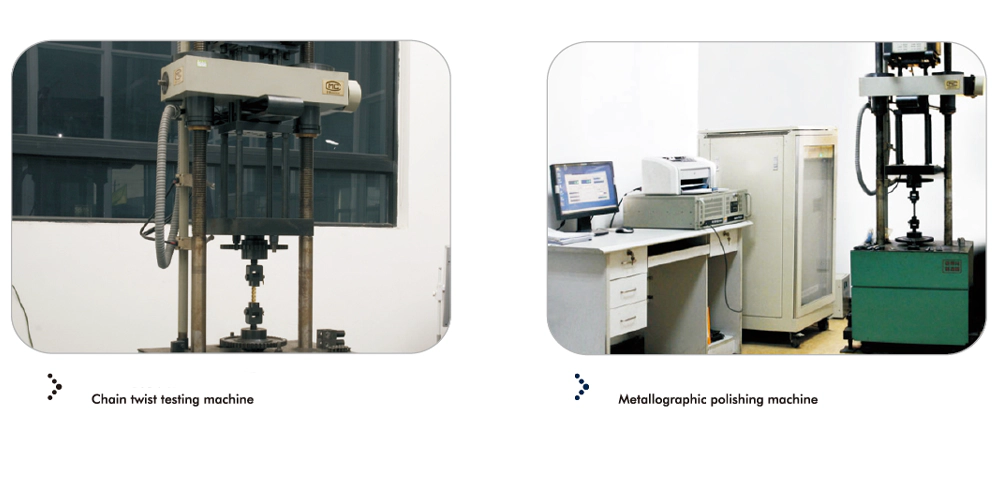
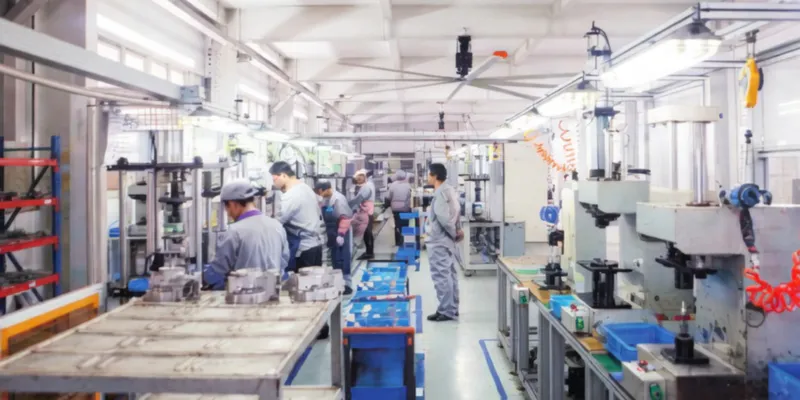
9. Related Products — Complete Drive System Solutions
A right-angle gear drive is rarely a standalone component — it functions as part of a broader mechanical drive system. We manufacture the full range of complementary power transmission products, giving you a genuine one-stop source for every element of your chain-and-sprocket or gear drive assembly. Sourcing all components from a single supplier eliminates the dimensional mismatches and tolerance stack-ups that arise when mixing parts from multiple manufacturers.
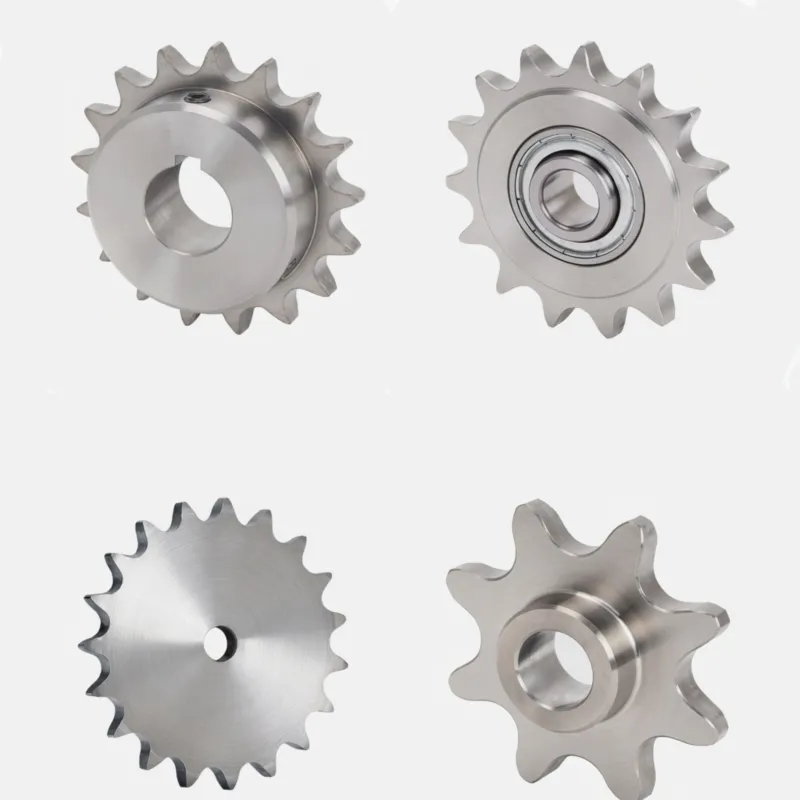
स्प्रोकेट
Our sprocket range covers ANSI and British Standard (BS) series across a wide array of tooth counts, pitch sizes, and bore configurations. Whether you need simplex, duplex, or triplex sprockets — in plain bore, finished bore, or taper-lock hub styles — these components integrate seamlessly with matched assemblies to complete your drive system. Stocking from the same supplier as your gear set simplifies maintenance scheduling and parts ordering.
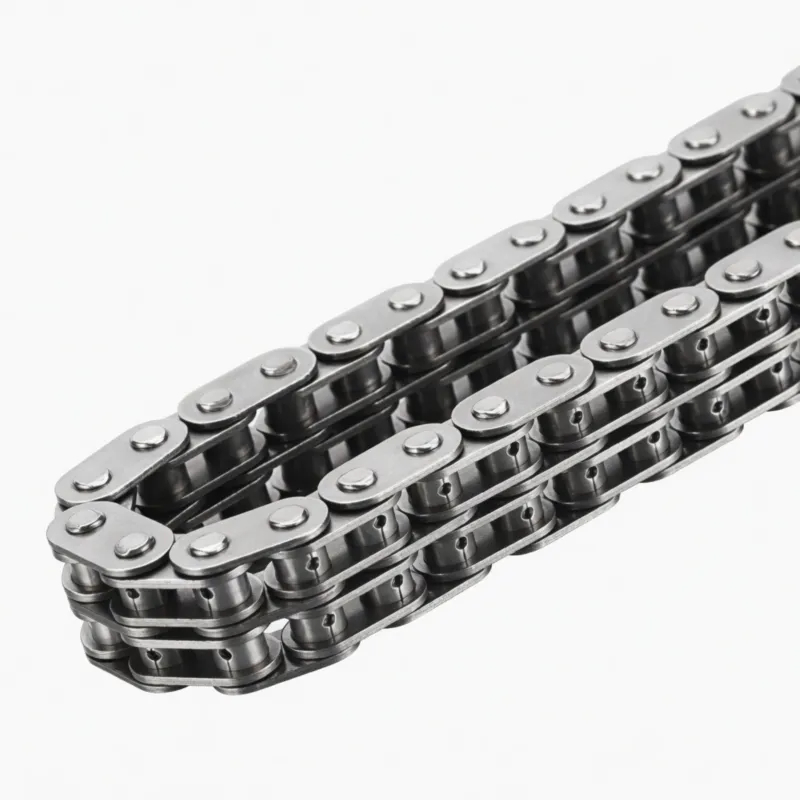
रोलर चेन
Roller chain is the natural companion to sprockets and is frequently used in the final power-delivery stage after a right-angle gear drive has redirected and reduced the drive speed. We supply British Standard (BS) and ANSI roller chains in simplex, duplex, and triplex configurations, along with extended-pitch agricultural chains, attachments, and connecting links. Combining our gear drive with a matched roller chain and sprocket gives you a complete, factory-coordinated transmission system.
अक्सर पूछे जाने वाले प्रश्नों
संपादक: पीएक्सवाई