Mô tả
Quick Summary
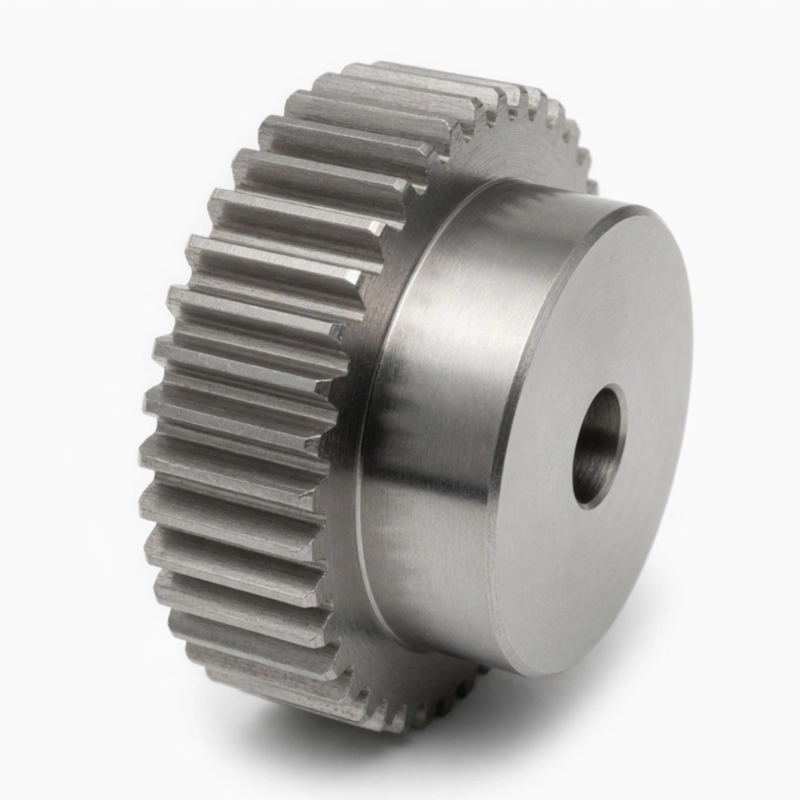
The EP-European Standard Series Spur Gear is a precision-machined, straight-tooth cylindrical gear engineered to European metric standards. Available in Module 1 through Module 2.5 (and beyond), these steel spur gears deliver efficient parallel-shaft power transmission for industrial machinery, agricultural equipment, and automation systems across Colombia and Latin America. All configurations are produced from C45 carbon steel with a 20° pressure angle, offering consistent meshing geometry and reliable torque transfer in demanding operating environments.
1. Technical Specifications – EP Spur Gears (Module 1 to Module 2.5)
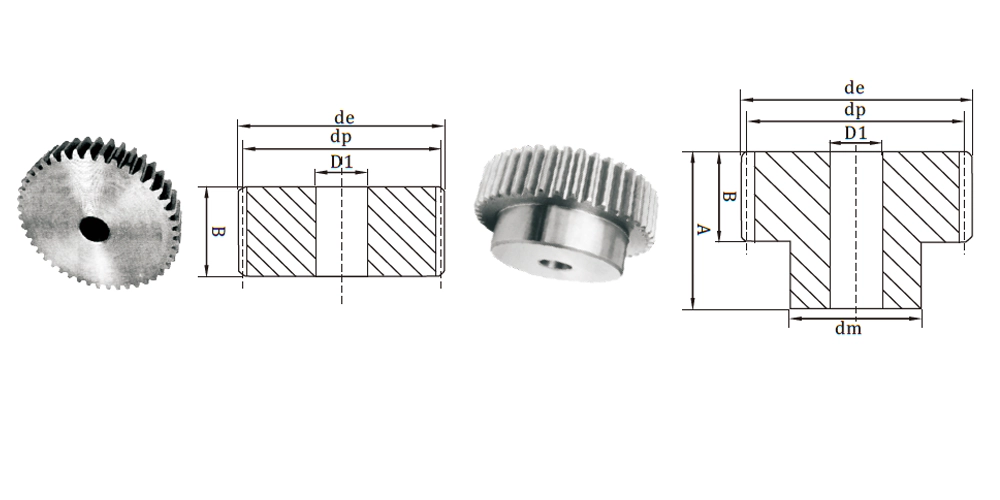
The table below lists representative dimensional data for the EP-European Standard Series across Mod.1, Mod.1.5, Mod.2, and Mod.2.5. All dimensions are in millimeters. Z = number of teeth; de = tip diameter; dP = pitch diameter; dm = root diameter; D1 = minimum bore diameter. These metric spur gears carry a 20° pressure angle and are produced from C45 steel.
| Z | Mod.1 | Mod.1.5 | Mod.2 | Mod.2.5 | ||||||||||||
|---|---|---|---|---|---|---|---|---|---|---|---|---|---|---|---|---|
| của | dp | dm | D1 | của | dp | dm | D1 | của | dp | dm | D1 | của | dp | dm | D1 | |
| 12 | 14 | 12 | 9 | – | 21.0 | 18.0 | 14 | 8 | 28 | 24 | 18 | 10 | 35.0 | 30.0 | 22 | 10 |
| 15 | 17 | 15 | 12 | – | 25.5 | 22.5 | 18 | 8 | 34 | 30 | 24 | 10 | 42.5 | 37.5 | 30 | 10 |
| 18 | 20 | 18 | 15 | 8 | 30.0 | 27.0 | 20 | 8 | 40 | 36 | 25 | 10 | 50.0 | 45.0 | 35 | 12 |
| 20 | 22 | 20 | 16 | 8 | 33.0 | 30.0 | 25 | 8 | 44 | 40 | 30 | 10 | 55.0 | 50.0 | 40 | 12 |
| 24 | 26 | 24 | 20 | 8 | 39.0 | 36.0 | 30 | 10 | 52 | 48 | 35 | 12 | 65.0 | 60.0 | 45 | 14 |
| 28 | 30 | 28 | 20 | 10 | 45.0 | 42.0 | 35 | 12 | 60 | 56 | 40 | 14 | 75.0 | 70.0 | 50 | 14 |
| 32 | 34 | 32 | 25 | 10 | 51.0 | 48.0 | 40 | 15 | 68 | 64 | 45 | 14 | 85.0 | 80.0 | 55 | 16 |
| 40 | 42 | 40 | 25 | 10 | 63.0 | 60.0 | 40 | 12 | 84 | 80 | 50 | 14 | 105.0 | 100.0 | 70 | 16 |
| 50 | 52 | 50 | 30 | 12 | 78.0 | 75.0 | 50 | 14 | 104 | 100 | 70 | 16 | 130.0 | 125.0 | 80 | 20 |
| 60 | 62 | 60 | 40 | 12 | 93.0 | 90.0 | 60 | 16 | 124 | 120 | 70 | 16 | 155.0 | 150.0 | 100 | 20 |
| 70 | 72 | 70 | 50 | 12 | 108.0 | 105.0 | 70 | 16 | 144 | 140 | 80 | 16 | 180.0 | 175.0 | – | 20 |
| 80 | 82 | 80 | 12 | 123.0 | 120.0 | 16 | 164 | 160 | 20 | 205.0 | 200.0 | 25 | ||||
| 100 | 102 | 100 | 12 | 153.0 | 150.0 | 16 | 204 | 200 | 20 | 255.0 | 250.0 | 25 | ||||
| 120 | 122 | 120 | 12 | 183.0 | 180.0 | 16 | 244 | 240 | 20 | 305.0 | 300.0 | 25 | ||||
Tooth Width “B” (mm)
Module 1 = 15 | Module 1.5 = 17
Module 2 = 20 | Module 2.5 = 25
Module 3 = 30 | Module 4 = 40
Module 5 = 50 | Module 6 = 60
Tooth Width “A” (mm)
Module 1 = 25 | Module 1.5 = 30
Module 2 = 35 | Module 2.5 = 45
Module 3 = 50 | Module 4 = 60
Module 5 = 75 | Module 6 = 80
2. What Is a Spur Gear?
A spur gear is one of the most fundamental and widely used gear types in mechanical engineering. Defined by its straight, parallel teeth cut radially on a cylindrical surface, a spur gear transmits rotational motion and torque between two parallel shafts with straightforward, predictable efficiency. Unlike helical gears — which feature angled teeth that engage gradually — the gear engages along the full tooth length simultaneously, producing a direct, no-nonsense power transfer. This characteristic makes it exceptionally easy to manufacture, straightforward to inspect, and simple to replace in the field, which is why industries ranging from food processing and textile manufacturing to conveyor systems and agricultural machinery have relied on this gear type for well over a century.
The term “spur” refers to the spur-like protrusions — the teeth — that project outward from the rim of the wheel. When two gears mesh, the teeth of the driving gear push against the teeth of the driven gear, transferring torque at a ratio proportional to the difference in tooth count (Z value). Because the contact line runs straight across the face width with no axial load component, radial bearings are all that’s required to support the shaft — simplifying housing design and keeping overall system costs low. This is one of the core reasons that metal spur gears remain the go-to choice for compact gearboxes, speed reducers, and gear trains where axial space is at a premium.
For buyers in Colombia and across the Andean region — whether in Bogotá’s manufacturing corridors, Medellín’s industrial parks, or Cali’s agro-industrial facilities — having access to in-stock, European-standard metric spur gears means faster equipment upkeep, reduced machine downtime, and smoother supply chains. Our EP-European Standard Series covers a broad spectrum of module sizes and tooth counts, ensuring that engineers and procurement teams can source the exact specification required without custom lead times or dimensional compromises. These follow the metric gear conventions to the dimensional conventions most industrial OEMs and maintenance teams recognize.
3. EP-European Standard Series Spur Gears – Product Overview
The EP-European Standard Series covers four primary module groups — Mod.1, Mod.1.5, Mod.2, and Mod.2.5 — each with tooth counts (Z values) beginning at Z12 and extending to Z127 and beyond. Within each module, three key dimensional parameters define the gear geometry: the tip diameter (de), the pitch diameter (dp), and the root diameter (dm), complemented by a minimum bore diameter (D1). This standardized layout allows engineers to cross-reference EP Series specifications directly against DIN 867 and ISO 54 metric gear conventions, meaning that an existing design using European metric gears can be updated or sourced using EP parts with confidence in dimensional compatibility.
Two distinct face-width configurations — referred to internally as Type A and Type B — accommodate different torque-capacity requirements without altering the pitch geometry. Type B tooth widths run from 15 mm at Module 1 up to 60 mm at Module 6, while Type A tooth widths start at 25 mm for Module 1 and reach 80 mm at Module 6. This means that a mechanical engineer designing a compact drive for a packaging machine and a civil infrastructure technician specifying a large conveyor reduction stage can both draw from the same EP Series catalog, simply selecting the appropriate face width for their load case. The result is a genuinely versatile line of steel spur gears that covers small spur gears and large spur gears within a single, coherent product family.
Every EP Series spur gear is manufactured to tight tolerances on pitch, involute profile, and concentricity. Pitch accuracy directly governs how smoothly the gear set runs and how evenly load is distributed across the tooth face — a parameter that has a direct bearing on gear fatigue life and noise output. Profile tolerances ensure that the theoretical involute form of the tooth flank matches the actual machined surface within specified limits, minimizing sliding friction and heat generation during mesh. Together these controls bring EP Series gear stock to a quality level supporting reliable operation in both light-duty intermittent applications and continuous-duty production equipment.
4. Working Principle of the Spur Gear
This spur gear type operates on the involute spur gear principle, where the tooth flank profile is derived from the involute of a base circle. When a driving gear rotates, the contact point between meshing teeth travels along the line of action — a straight line tangent to both base circles — at the standard 20° pressure angle used in EP Series parts. This geometry guarantees a constant velocity ratio between the input and output shafts throughout the meshing cycle, which is fundamental to smooth, vibration-free power transmission. The 20° pressure angle represents the global engineering consensus for general-purpose spur gear applications: it provides a balance between tooth strength (thicker tooth root compared with lower pressure angles) and smooth engagement (less sensitivity to center-distance variation compared with higher pressure angles).
Contact ratio — the average number of tooth pairs simultaneously in contact — is a key performance parameter for any spur gear pair. In well-designed metric gear meshes, the contact ratio typically falls between 1.3 and 1.8, meaning that at any instant during rotation, one to two tooth pairs share the transmitted load. Higher contact ratios spread load more evenly, reduce peak tooth stress, and lower noise levels. The EP Series dimensional standards, combined with the 20° pressure angle and standard addendum coefficients, are set to achieve contact ratios well within this optimal range across the full Z12–Z127 tooth-count spectrum.
An important practical distinction when comparing spur gear vs helical gear designs: spur gears generate purely radial tooth forces with no axial (thrust) load component. This simplifies shaft and bearing selection considerably — standard deep-groove ball bearings are sufficient in most configurations, and housing designs need not accommodate thrust flanges or angular-contact bearing pairs. For industrial users in Colombia and the broader Latin American market who maintain large inventories of spare parts, this interchangeability of standard bearing types is a real operational advantage. It is also one reason why the mechanical spur gear continues to dominate gear-train designs where cost, repairability, and availability of replacement parts matter more than absolute noise reduction.
5. Five Key Advantages of the EP-European Standard Spur Gear
① Full European Metric Compliance
Dimensions conform to DIN 867 and ISO 54, making these metric spur gears a direct drop-in for European-designed machinery without the need for custom adaptors or dimensional adjustment. Engineers in Colombia and across Latin America who maintain European-origin production lines can source replacement gears with zero dimensional risk.
② C45 Steel with Heat Treatment Option
The base material, C45 medium-carbon steel, provides an excellent combination of machinability and structural strength. Normalized or induction-hardened versions are available depending on application duty, extending the effective service life of the gear pair under high-cycle or heavy-load conditions commonly found in industrial drives and agricultural machinery.
③ Wide Range from Small to Large Spur Gears
From Z12 with a tip diameter of 14 mm (Module 1) to Z120 and beyond with diameters exceeding 300 mm (Mod.2.5), the EP Series covers small spur gears for compact mechanisms and large spur gears for heavy-duty reducers — all within one catalog, from a single gear supplier, with consistent quality standards.
④ Two Face-Width Configurations
The availability of both Type A (wider face) and Type B (standard face) configurations for every module means that the same pitch geometry serves both standard-duty and enhanced-capacity installations. Buyers can specify the torque capacity they need without switching to a different gear type or sourcing from a second supplier, supporting leaner procurement and simpler spare-parts management.
⑤ Ready Stock for Fast Dispatch
Popular tooth counts across Mod.1–Mod.2.5 are held in spur gear stock for rapid dispatch, reducing lead times for urgent maintenance requirements. Whether you need a handful of small spur gears to restore a production line or a bulk order to stock a regional distribution hub in Bogotá, Medellín, or Cali, immediate availability translates directly into reduced machine downtime and lower total cost of ownership.
6. Material & Construction
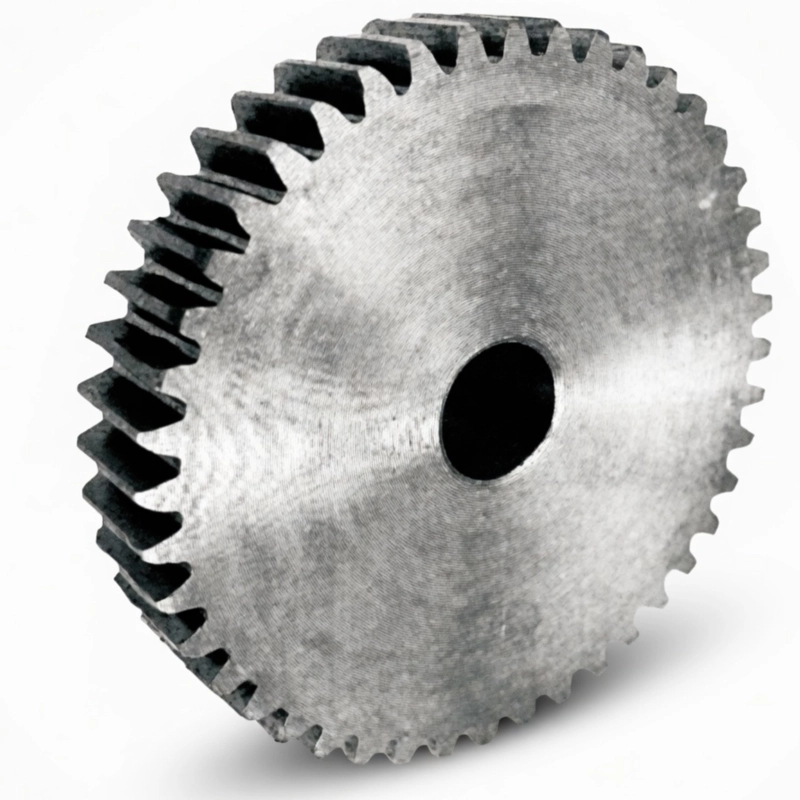
Every EP-European Standard gear in this series is produced from C45 medium-carbon steel, a material that sits at the intersection of good machinability and solid mechanical performance. C45 carries a nominal carbon content of 0.45% by weight, which — following appropriate heat treatment — delivers tensile strength values in the range of 620–850 MPa (normalized condition) with hardness approaching HB 200–240. For applications demanding greater surface wear resistance, tooth flanks can be induction hardened to 45–55 HRC while retaining a tougher, un-hardened core, a combination that resists both surface pitting and subsurface fatigue crack initiation. All stock spur gears carry a 20° pressure angle as standard, and all steel spur gears in the EP Series are manufactured against an involute profile tolerance grade compatible with DIN 3963/ISO 1328 quality class 8 or better, depending on module.
The hub bore (D1) dimensions listed in the specification table represent minimum bore values as machined. For custom spur gears, bores can be finished to customer-specified H7 tolerance fits, and keyways or set-screw holes can be machined to DIN 6885 or equivalent standards on request. This flexibility makes the EP Series suitable both as an off-the-shelf spur gear stock solution and as the basis for custom-finished drive components for OEM machinery builders and systems integrators operating across Colombia’s diverse manufacturing sectors — from food and beverage processing in the Valle del Cauca region to mining equipment in Antioquia.
Tooth surfaces are finish-hobbed and deburred, ensuring clean tooth profiles with no residual burrs that could accelerate lubricant breakdown or generate metallic contamination in sensitive drive environments. Where required, case-hardened or nitrided surface treatments are available as premium options for applications involving high-frequency cycling, borderline lubrication conditions, or elevated temperature environments. The result is a spur gear component that performs reliably from initial installation through thousands of operating hours, underpinned by material and manufacturing practices that support traceable quality documentation for compliance-sensitive industries.
7. Các kịch bản ứng dụng
The EP-European Standard Spur Gear finds deployment wherever parallel-shaft power transmission is required and where simplicity, maintainability, and sourcing flexibility matter. The following scenarios represent the most common use cases encountered by industrial buyers and maintenance engineers across Colombia and the broader Latin American market.
Industrial Conveyor & Handling Systems
These spur gears are the workhorses of conveyor drive heads, cross-transfers, and accumulation tables found in Colombian distribution centers, logistics hubs, and manufacturing plants. Their high efficiency (typically 98–99% per mesh) and straightforward replacement procedure make them the preferred choice for maintenance teams prioritizing fast, low-cost upkeep of continuous-operation systems.
Agricultural & Agro-Industrial Machinery
From seed drills and grain augers to sugar cane harvesters and irrigation pump drives, agricultural machinery across Colombia’s coffee, sugar, and banana growing regions depends on rugged, field-maintainable spur gear stages. Having EP Series parts in stock means replacement parts can be procured regionally without long international lead times that translate to costly crop losses.
Packaging & Food Processing Equipment
Speed reducers and timing drives in filling, sealing, and labeling machines rely on small spur gears with tight pitch accuracy to maintain correct product-to-package synchronization. Where food-grade stainless steel gears are required by hygiene regulations — such as Colombia’s INVIMA food safety framework or the applicable sections of ISO 22000 — stainless steel variants are available upon request.
Printing & Paper Industry Drives
Sheet-fed printing presses, platen cutters, and laminating lines use precision metric spur gears at multiple points in the paper path to maintain register accuracy. The tight involute profile tolerances achievable with EP Series gears support low backlash registration in multi-color and die-cutting applications, where positional error at even half a millimeter can render an entire print run unusable.
Construction & Mining Equipment
Large gears in the Mod.2–Mod.2.5 range, particularly those at Z80–Z120, are used in hoist mechanisms, winch drums, and rock crusher feed drives common in Colombia’s mining corridors and infrastructure construction sectors. Selecting the wider Type A face-width configuration for these heavy-duty applications distributes tooth load over a greater area, improving fatigue resistance and extending overhaul intervals.
8. Industry Standards & Regulatory Context
Spur gear procurement and application in Colombia and across the Andean region sits within a well-defined framework of both international technical standards and local regulations. Understanding this context helps procurement engineers and compliance managers make informed sourcing decisions and demonstrate regulatory fitness to inspectors and auditors.
International Standards: The dimensional conventions used in EP Series gears align with ISO 54 (modules and diametral pitches for cylindrical gears), DIN 867 (basic rack tooth profile for metric gears), ISO 1328-1 (accuracy grade definitions for cylindrical gear flanks), and ISO 6336 (calculation of load capacity for spur and helical gears). ISO 6336 in particular provides the engineering basis for selecting the appropriate module and face width for a given torque, speed, and material combination — the methodology used during EP Series design validation. The 20° standard pressure angle employed by EP Series gears is defined in ISO 53 and AGMA 913.
Colombia & Andean Region: ICONTEC (Instituto Colombiano de Normas Técnicas y Certificación) administers Colombia’s NTC (Norma Técnica Colombiana) standards program and has adopted numerous ISO mechanical engineering standards relevant to gear procurement. For machinery safety, Resolución 1409 of 2012 (Ministerio de Trabajo) establishes work-at-height safety requirements that affect crane and hoist applications involving large spur gears, while Decree 1072 of 2015 consolidates Colombia’s occupational safety and health regulations applicable to machinery and equipment maintenance. For food-contact applications, INVIMA Resolution 2013019088 and the applicable HACCP framework govern material selection for gear components in food processing environments — a relevant consideration when specifying stainless steel spur gears. Ecuador, Peru, and Bolivia, as CAN (Andean Community) member states, share aligned technical trade regulations through Decisión 562, facilitating the import and use of internationally standardized gear components across the bloc.
9. About Us-Spur Gear Manufacturer
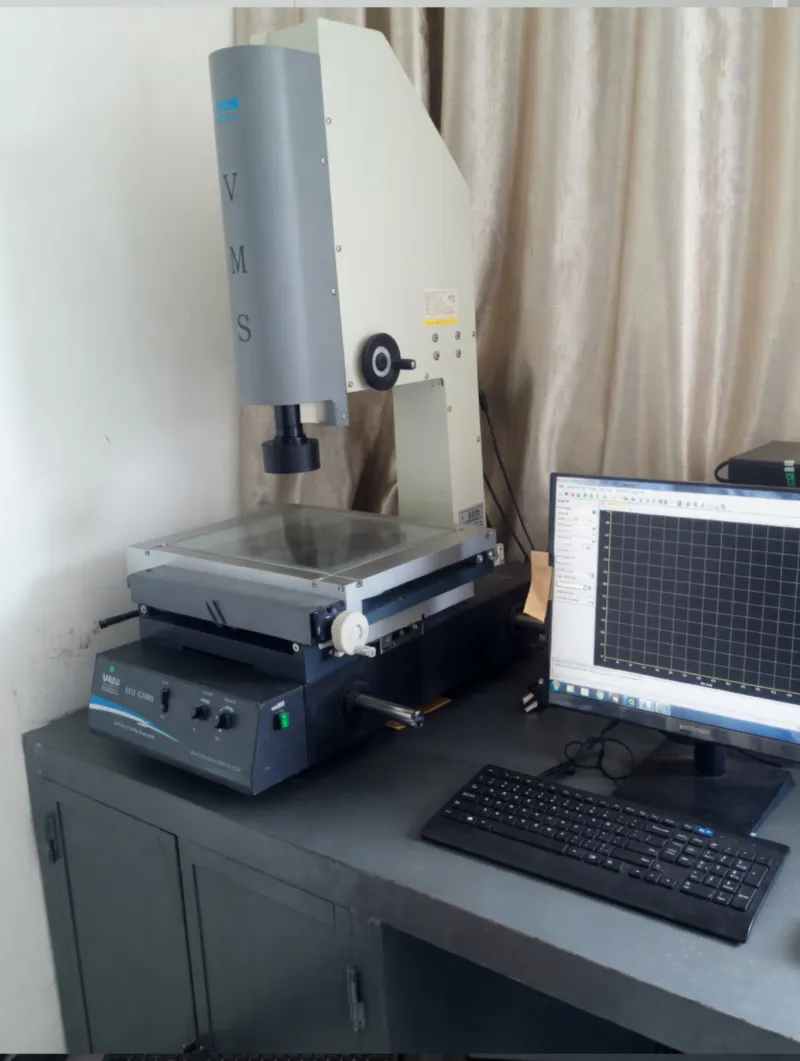
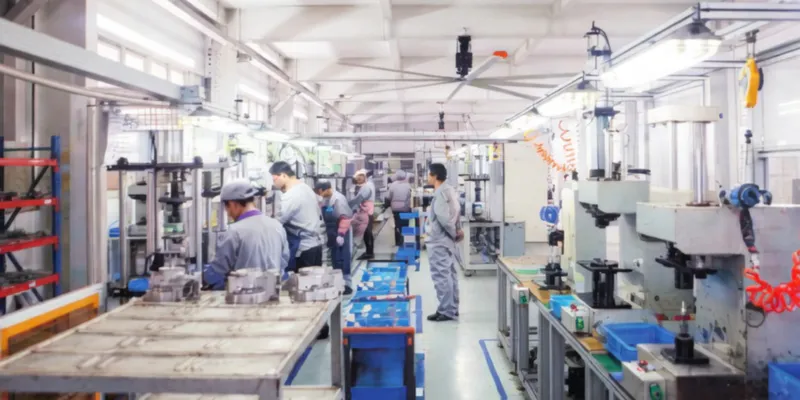
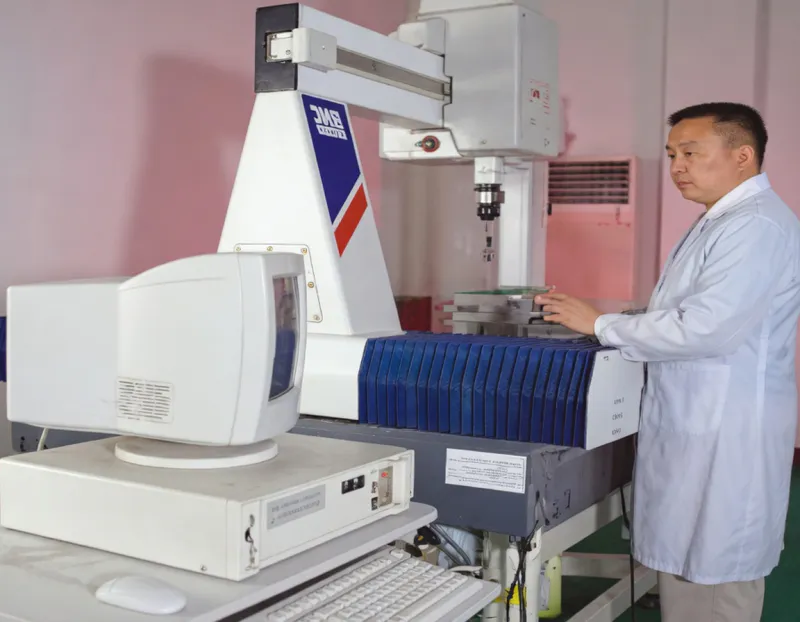
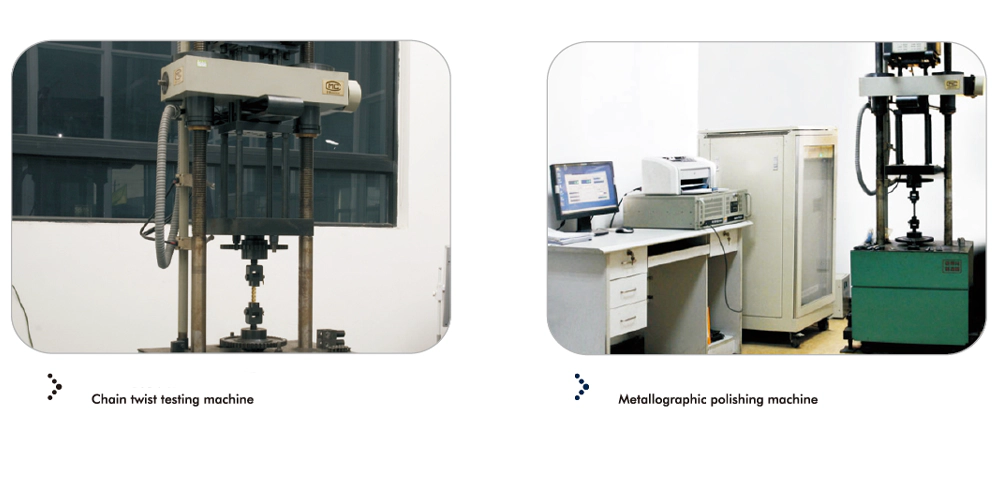
We are a specialist manufacturer and global gear supplier focused on precision power transmission components for industrial, agricultural, and OEM applications. Our engineering team brings decades of hands-on experience in gear design, tooling, and quality systems, allowing us to produce metric spur gears, sprockets, chains, and related drive components that consistently meet or exceed customer dimensional and performance specifications. Every product line we carry — including the EP-European Standard Series — is backed by documented inspection data and full traceability through the production process.
Xưởng
10. Related Products
Bánh răng
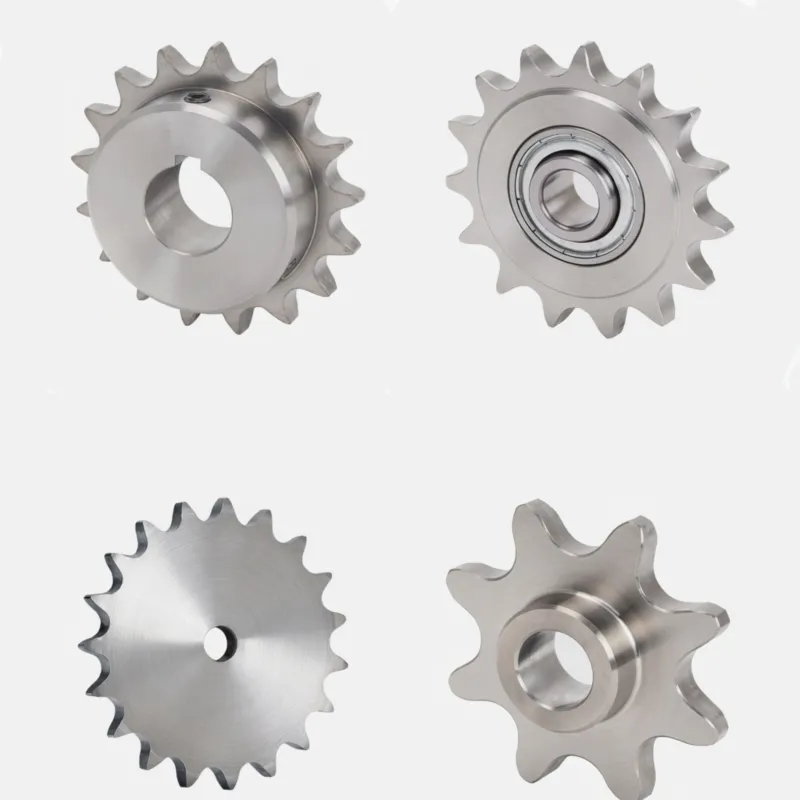
Độ chính xác của chúng tôi bánh răng are fully compatible with standard drive chains and integrate seamlessly alongside gear stages in mixed drive trains. Combining EP Series spur gears with our matched sprocket range gives engineers a one-stop solution for parallel-shaft and chain-drive segments within a single machine, simplifying procurement and ensuring dimensional compatibility throughout the power transmission system.
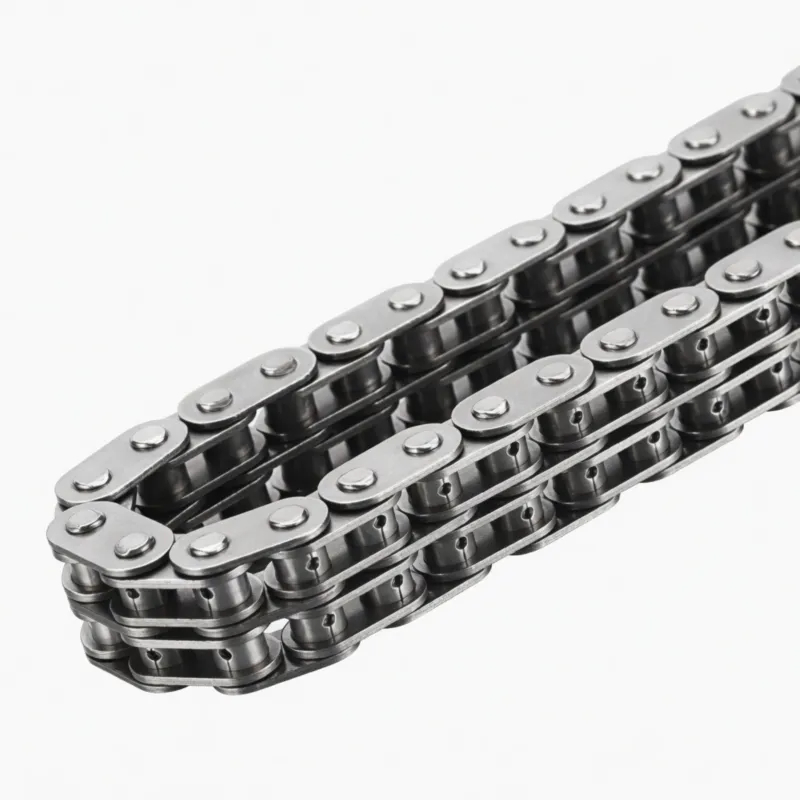
Complete your drive system with our standard and heavy-duty roller chains, engineered to work in tandem with our sprocket and spur gear product families. Sourcing chains, sprockets, and spur gears from a single supplier means consistent quality grades, matched pitch specifications, and unified technical support — a genuine one-stop supply advantage for industrial buyers managing complex machinery fleets in Colombia and across the Andean region.
Câu hỏi thường gặp
Biên tập viên: PXY