விளக்கம்
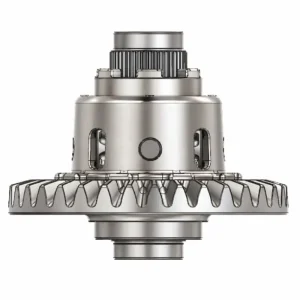
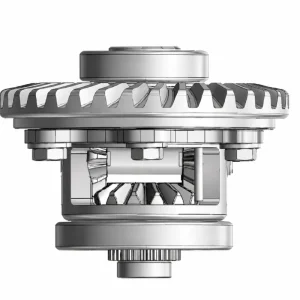
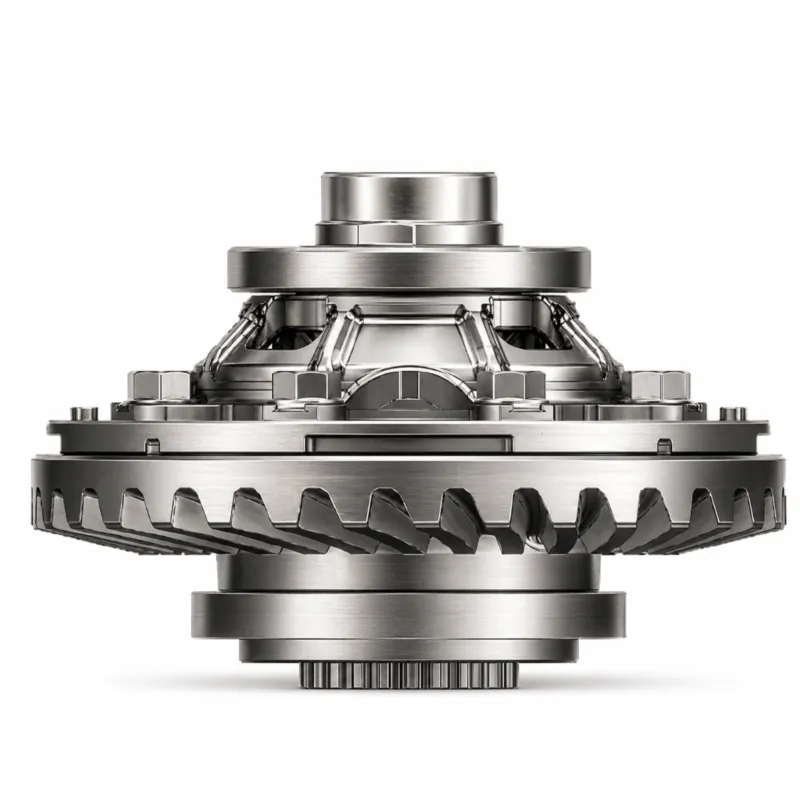
EP-1000 Front Axle Differential Assembly — Compact Planetary Differential for ATV & UTV Drivetrains
1. Technical Specifications — EP-1000 Front Axle Differential Assembly
The table below lists the 20 verified technical parameters for the EP-1000 front axle differential assembly. Spline geometry, dimensions, and weight values are direct measurements from production units; performance values reflect the rated operating envelope of the assembly.
| அளவுரு | Specification / Value |
|---|---|
| Model Number | EP-1000 |
| Product Type | Front Axle Differential Assembly (compact planetary) |
| Differential Mechanism | Planetary gear open differential |
| Maximum Input Torque (T max) | 1,000 N·m |
| Maximum Input Rotation Rate (n max) | 4,500 RPM |
| Centre-to-Centre Spacing (A) | 78 mm |
| Gear Ratio (U) | 4.10 : 1 |
| Input Spline Type | Internal spline |
| Input Spline Module (m) | 4.3137 |
| Input Spline Teeth (z) | 14 |
| Input Spline Pressure Angle (a) | 22.5° |
| Input Profile Shift Coefficient (x) | -0.2243 / -0.027 |
| Output Spline Type | Internal spline |
| Output Spline Module (m) | 2 |
| Output Spline Teeth (z) | 23 |
| Output Spline Pressure Angle (a) | 30° |
| Output Profile Shift Coefficient (x) | -0.2243 / -0.027 |
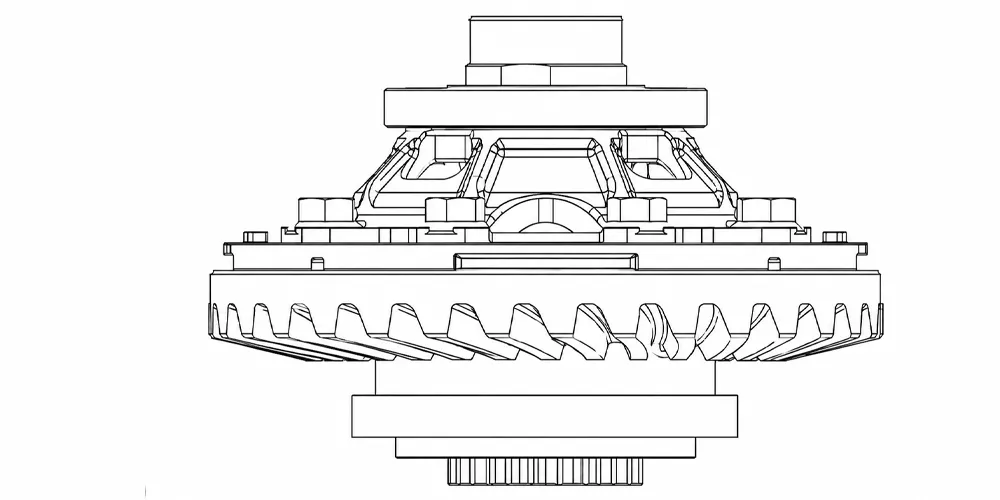
| Outer Dimensions (L × W × H) | 166 mm × 166 mm × 114 mm |
| Net Weight | 5.1434 kg |
| Material / Surface Hardness | 20CrMnTi alloy steel, carburized HRC 58–62 (core HRC 33–40) |
2. Five Key Product Advantages of the EP-1000 Front Axle Differential Assembly
1. Compact Planetary Architecture
The EP-1000 front axle differential assembly is structured as a compact planetary differential, meaning the working principle does not depend on bevel side gears arranged perpendicular to the axle centreline. Instead, planet gears rotate on their own axes within the housing, directly distributing input torque to the two output spline interfaces. This configuration produces a shorter axial length and a smaller overall envelope than a traditional bevel-gear differential of equivalent torque rating. For Colombian ATV manufacturers and aftermarket workshops working with tight axle housing constraints, the compact front axle differential assembly envelope is decisive — the unit fits cleanly into 700-class and 800-class ATV chassis envelopes without requiring custom housing modifications, reducing engineering retrofitting time and simplifying parts compatibility across multiple vehicle generations.
2. Precision-Calculated Spline Interfaces
The input and output spline parameters of the EP-1000 front axle differential assembly have been calculated to match the dominant ATV/UTV driveline standards. The input internal spline runs at module 4.3137, 14 teeth, 22.5° pressure angle, with a profile shift coefficient of −0.2243/−0.027 — values intentionally aligned with the propeller shaft termination geometry used on common 700–1000 cc ATV powertrains. The output internal spline at module 2, 23 teeth, 30° pressure angle accepts standard ATV half-shaft splines without modification. This dimensional discipline within the front axle differential assembly eliminates the integration ambiguity that plagues low-cost front axle differential alternatives sourced from non-specialized vendors, where dimensional drift between batches forces workshops in Colombia to perform expensive on-vehicle fitting work.
3. Hardened Alloy-Steel Build
The differential housing, planet gears, and side gears of the EP-1000 front axle differential assembly are produced from carburized 20CrMnTi alloy steel — the same material class used for high-load transmission gears in commercial vehicles. After carburizing, quenching, and tempering, the gear contact surfaces achieve HRC 58–62 hardness while the core retains HRC 33–40 toughness, providing the dual-property profile needed for impact-laden off-road duty cycles. This material specification ensures that the front drive axle differential can sustain the torque spikes generated when an ATV exits a mud bog, lands from a small drop, or experiences momentary wheel slip on the steep grades typical of the Colombian Andes — the operating conditions where lower-quality differentials commonly fail at the planetary gear teeth.
4. Verified Weight and Dimensions
At a measured weight of 5.1434 kg with overall dimensions of 166 mm length × 166 mm axle-track width × 114 mm height, the EP-1000 front axle differential assembly sits in a sweet spot between mass and torque capacity. The lower rotational inertia compared to oversized differential units improves throttle response and reduces the parasitic energy losses that accumulate in continuous-use applications such as agricultural ATVs, security patrol UTVs, and recreational rental fleets. For Colombian buyers comparing the EP-1000 front axle differential assembly against potential alternatives, the published weight and dimension figures are not nominal — they are the measured physical values of the production unit, which simplifies logistics planning and cargo manifest preparation when shipping the front axle differential assembly to inland destinations such as Medellín, Cali, or Bucaramanga.
5. One-Stop Driveline Supply
Beyond the front axle differential assembly itself, our manufacturing programme covers the complete front axle assembly ecosystem — wheel bolts, trailer axle beams, trailer spindles, half-shaft components, and matching driveline accessories. For Colombian dealerships, fleet operators, and OEM rebuilders this means a single procurement contact can fulfil a complete front differential replacement kit, including all the auxiliary fasteners and seals that turn a standalone differential into a ready-to-install assembly. This integrated supply approach materially reduces logistics complexity, minimizes shipping consolidation costs, and removes the dimensional compatibility risks that arise when sourcing differential units and matching wear parts from disconnected vendors.
3. What is a Front Axle Differential and What Does the EP-1000 Deliver?
ஒரு front axle differential is the gear assembly mounted between the two front half-shafts of a four-wheel-drive or all-wheel-drive vehicle that allows the left and right wheels to rotate at different speeds while continuing to receive engine torque. The need for this rotational difference arises any time the vehicle turns a corner — the outer wheel travels along a longer arc than the inner wheel and must rotate faster to avoid scrubbing the tyre and binding the driveline. Without a working front axle differential assembly, every steering input on a powered front axle would produce mechanical stress on the half-shafts and tyres, dramatically reducing component life. This is the function of front axle differential gearing in every modern 4×4 platform.
The EP-1000 implements this function through a planetary gear differential mechanism rather than the more common bevel-gear arrangement. Drive torque enters the unit through the input spline, which couples directly to the propeller shaft. The torque drives the planet carrier, which holds multiple planet gears in mesh between the two output side gears. When the vehicle moves in a straight line, all planet gears rotate together with the carrier and both outputs spin at identical speeds. When the vehicle turns, the planet gears begin to rotate on their own axes, allowing the outer-wheel side gear to spin faster than the inner-wheel side gear. The result is a smooth speed differentiation that maintains traction on both wheels while preserving the geometric integrity of the front axle.
The compact 1000-class designation in the EP-1000 naming refers to the torque rating tier, positioning this front axle differential assembly within the operating range typical of 700–1000 cc utility ATVs and side-by-side UTVs. The EP-1000 front axle differential assembly is supplied as a fully assembled, factory-tested drop-in component rather than a kit of loose gears requiring customer assembly. Each front axle differential assembly unit is bench-tested for backlash, rotational drag, and gear engagement quality before packaging — a quality discipline that is consistent with the production practices documented in our manufacturing facility records and supports the front axle differential replacement market segment, where workshop installers demand parts that perform correctly on the first installation attempt.
4. Working Principle of the Compact Planetary Differential
The fundamental working principle of the EP-1000 front axle differential assembly can be understood by tracing the torque path through the unit from input spline to output spline. When the propeller shaft rotates the input internal spline (module 4.3137, 14 teeth), the connected ring carrier inside the front axle differential assembly housing transmits that rotation to the planet carrier. The planet carrier holds an array of planet gears that are simultaneously meshed with both the left and right side gears. These side gears are the ones that interface with the output internal splines (module 2, 23 teeth) leading to the half-shafts. In straight-line driving, the planet gears do not rotate on their own axes within the front axle differential assembly — they rotate as a rigid block with the carrier, transmitting equal torque and equal rotational speed to both half-shafts.
The differential action begins the moment one wheel encounters a different rotational demand than the other. This happens during cornering, when one wheel encounters a low-traction surface, or when the suspension geometry causes one wheel to travel a different distance than the other. In any of these cases, the planet gears begin rotating on their own axes within the carrier. The geometry of the planetary front axle differential is such that any speed gain on one side gear is exactly compensated by an equal speed loss on the opposite side gear — the average of the two output speeds always equals the input speed. This kinematic relationship is the same fundamental property that makes any open differential function, whether implemented as a bevel-gear differential or as the more compact planetary differential used in the EP-1000.
The torque distribution in an open front axle differential assembly like the EP-1000 follows a different rule than the speed distribution: torque is split equally between the two output sides regardless of their relative speeds. This means that if one wheel encounters near-zero traction (mud, ice, or a hanging wheel), the torque on that wheel approaches zero, and because torque is split equally, the opposite wheel also receives near-zero torque — this is the limitation of any open differential without a locking mechanism. For severe-duty Colombian off-road applications where this limitation matters, the EP-1000 platform supports the integration of a separate differential lock or limited-slip mechanism in the upstream driveline, addressing the diff lock symbol functionality common in 4×4 ATVs intended for serious mud and rock terrain operation.
5. Material Selection for the Front Axle Differential Assembly
The material specifications applied to the EP-1000 front axle differential assembly were chosen specifically to address the load profile of small-to-medium off-road powertrains. The dominant failure modes that must be designed against are tooth pitting on the planet and side gears, fracture of gear teeth from impact loads, and wear of the spline interfaces from cyclic micro-motion. Each material decision in the assembly addresses one or more of these failure modes directly.
20CrMnTi Alloy Steel — Planet Gears, Side Gears, and Differential Carrier. This case-hardening alloy steel is the workhorse material for vehicle transmission gears and drivetrain components in commercial and off-road applications. After gas carburizing at 920°C, oil quenching, and low-temperature tempering, the gear tooth flanks within the front axle differential assembly reach HRC 58–62 surface hardness — sufficient to resist Hertzian contact pitting fatigue under the load cycles encountered by a 1,000 N·m-rated front axle differential assembly. The retained core hardness of HRC 33–40 provides the bending toughness necessary to absorb impact loads without tooth root cracking. This is the same material class used in commercial truck differentials, scaled here to the dimensions appropriate for ATV/UTV applications.
SCM440 / 42CrMo4 Alloy Steel — Differential Housing. The outer housing of the EP-1000 front axle differential assembly is produced from medium-carbon chromium-molybdenum alloy steel, which combines good machinability with strong fatigue performance after quench-and-temper heat treatment. Housing hardness is targeted at HRC 28–32 to maintain dimensional stability through the long thermal cycles experienced in continuous-duty applications.
Bearing-Grade Steel — Internal Bearings. The needle and ball bearings supporting the planet gears and side gears inside the front axle differential assembly are manufactured from GCr15 (SAE 52100) bearing steel hardened to HRC 60–62, the established standard for rolling-element bearings in transmission applications.
Nitrile Rubber Seals. Output shaft seals are produced from NBR (nitrile butadiene rubber) compounded for compatibility with petroleum-based gear oils across the temperature range typical of Colombian climate zones — from cool highland operating temperatures to the elevated ambient temperatures encountered in lowland tropical regions.
6. பயன்பாட்டுச் சூழ்நிலைகள்
The EP-1000 front axle differential assembly serves a defined range of applications matched to its torque rating, dimensional envelope, and spline interface specifications. The application scenarios below represent the dominant deployment profiles where this front differential 4×4 component delivers the best fit between technical capability and operating economics.
Utility ATV — Coffee & Cattle Operations
On Colombian coffee farms in Caldas, Quindío, and Risaralda, utility ATVs provide essential mobility across steep, narrow plantation tracks where pickup trucks cannot operate. The EP-1000 front axle differential assembly is matched to the typical 700–1000 cc utility ATV powertrain, delivering the front-axle torque distribution needed for hauling small loads of harvested coffee cherries between plots. Cattle operations across the Llanos region use similar utility ATVs for fence inspection and herd management, where the reliability of the front drive axle differential directly determines operational uptime. The compact 166 × 166 × 114 mm form factor of the unit makes it suitable for retrofit into existing utility ATV chassis without modification.
Side-by-Side UTV — Recreational and Tourism
The recreational off-road tourism segment in regions such as Tatacoa Desert, San Agustín, and Guajira increasingly relies on side-by-side UTVs as guided-tour platforms. These vehicles operate in dust, sand, and uneven rocky terrain, demanding a front axle differential assembly capable of sustaining repeated daily duty cycles without performance degradation. The EP-1000 front axle differential assembly uses a planetary differential geometry that distributes load across multiple planet gears, reducing peak tooth stress compared to two-pinion bevel-gear designs of equivalent torque rating. Tour operators specifying front differential replacement components for their UTV fleets benefit from the EP-1000’s verified manufacturing standards and predictable service life characteristics.
Security & Patrol Vehicles
Private security companies, ranger services in national parks, and rural municipal patrol units across Colombia operate fleets of small 4×4 vehicles where reliability and parts availability drive procurement decisions. The EP-1000 front axle differential assembly serves these applications as a robust, supportable drivetrain component. Standard spline interfaces and documented dimensional specifications mean replacement front axle differential assembly units can be sourced and stocked predictably, eliminating the parts-availability risks that plague fleets using non-standard or custom-machined differential assemblies. For fleet maintenance managers in Bogotá, Medellín, and Cali, this supply predictability translates directly into reduced vehicle downtime.
Agricultural Spraying Vehicles
Specialized agricultural spraying ATVs and small UTVs operate continuously across crop rows in Colombian banana, palm, and rice plantations. The continuous-duty cycle of these machines exposes the front axle differential assembly to thermal load conditions that exceed those of recreational use. The 20CrMnTi carburized gear set at HRC 58–62 inside the EP-1000 front axle differential assembly, combined with the planetary architecture’s load-sharing characteristics, provides the durability margin appropriate for these continuous applications. The documented input torque rating of 1,000 N·m provides comfortable headroom above the typical operating torque of agricultural ATV powertrains.
Industrial & Mining Light Utility
Light utility 4×4 vehicles serving Colombian mining operations in Antioquia and Cesar — particularly internal logistics vehicles operating within mine perimeters — depend on robust front axle differential assembly components to handle dusty, gravel-laden operating conditions. The EP-1000’s sealed-housing construction and NBR output shaft seals retain lubricant integrity in these abrasive environments. The standardized spline geometry simplifies field replacement, allowing mine maintenance crews to perform a front axle differential replacement using basic workshop tools rather than specialized mining-fleet service equipment.
OEM Assembly & Aftermarket Rebuild Kits
For Colombian assembly partners producing localized ATV/UTV variants, and for aftermarket workshop networks supplying vehicle transmission rebuild kits front axle differential components, the EP-1000 functions as a verified building block. The assembly arrives with full dimensional documentation, material certificates, and bench-test records, removing the engineering verification burden from the receiving party. This documentation discipline is essential for OEM-level integration and for aftermarket suppliers building rebuild kits compliant with vehicle technical regulations applicable in Colombia and other Andean Pact countries.
7. Regulatory Standards and Compliance Considerations
Buyers procuring a front axle differential assembly for use in Colombian-registered vehicles or for incorporation into vehicles assembled in Colombia operate under a multi-layered regulatory environment. Understanding these regulations is essential for ensuring that supplied differential components do not create downstream compliance issues for the vehicle owner or assembler.
Colombia (ICONTEC, Ministerio de Transporte, RUNT). Vehicle drivetrain components installed in Colombian-registered vehicles must be consistent with the technical requirements administered by the Ministerio de Transporte and the Registro Único Nacional de Tránsito (RUNT) registration framework. ICONTEC (Instituto Colombiano de Normas Técnicas y Certificación) publishes Norma Técnica Colombiana (NTC) standards covering numerous mechanical component categories, with NTC standards frequently aligning with ISO international standards. For ATV and UTV vehicles, additional requirements apply under Resolución 3768 de 2013 of the Ministerio de Transporte, which establishes technical inspection criteria. While the front axle differential assembly itself is rarely the subject of direct certification, its physical integration into a registered vehicle places it within the scope of these inspection regimes.
Andean Community (CAN) Regulations. As a member of the Comunidad Andina, Colombia participates in regional technical harmonization initiatives that influence vehicle component requirements across Bolivia, Ecuador, and Peru. Decision 506 of the CAN provides for mutual recognition of conformity assessment in member states, simplifying the importation pathway for compliant front differential assembly components destined for distribution across Andean markets.
European Union (EU 2018/858). Vehicles incorporating a front axle differential assembly destined for the EU market must comply with Regulation (EU) 2018/858 on the approval and market surveillance of motor vehicles, replacing the earlier framework directive. Drivetrain components in CE-marked machinery are also covered by Machinery Directive 2006/42/EC where applicable. Documentation supporting CE conformity is available for the EP-1000 on request to support European-market buyers.
United States (FMVSS, EPA, AGMA). US-market vehicles fall under the Federal Motor Vehicle Safety Standards administered by NHTSA, with additional EPA emissions and noise regulations. Drivetrain gear components are commonly designed to AGMA 2001-D04 fundamental rating standards. The EP-1000 front drive axle differential is engineered consistent with AGMA gear-rating methodology, supporting buyers integrating units into vehicles destined for the US market.
International Standards. The EP-1000 front axle differential assembly design and manufacturing process align with ISO 6336 for gear load capacity calculation, ISO 1328-1 for cylindrical gear flank tolerance classification, and ISO 9001:2015 for the supplier’s quality management system. These international references provide a common technical language across multi-market procurement programs and simplify the qualification process when integrating the EP-1000 front axle differential assembly into vehicles destined for export from Colombia to neighboring Andean Community markets or to the broader Latin American region.
8. எங்களைப் பற்றி
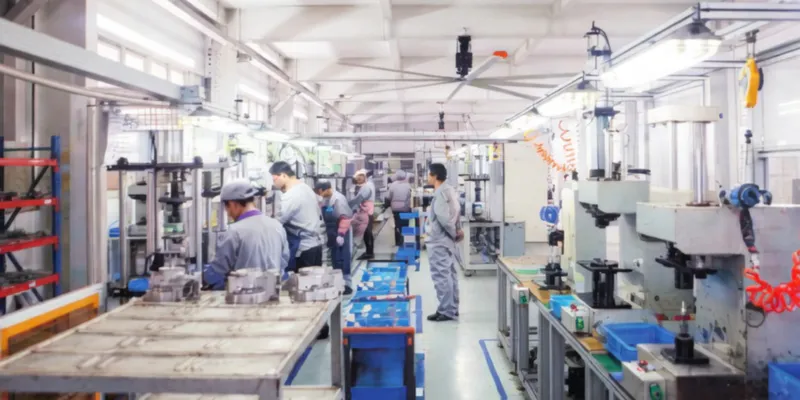
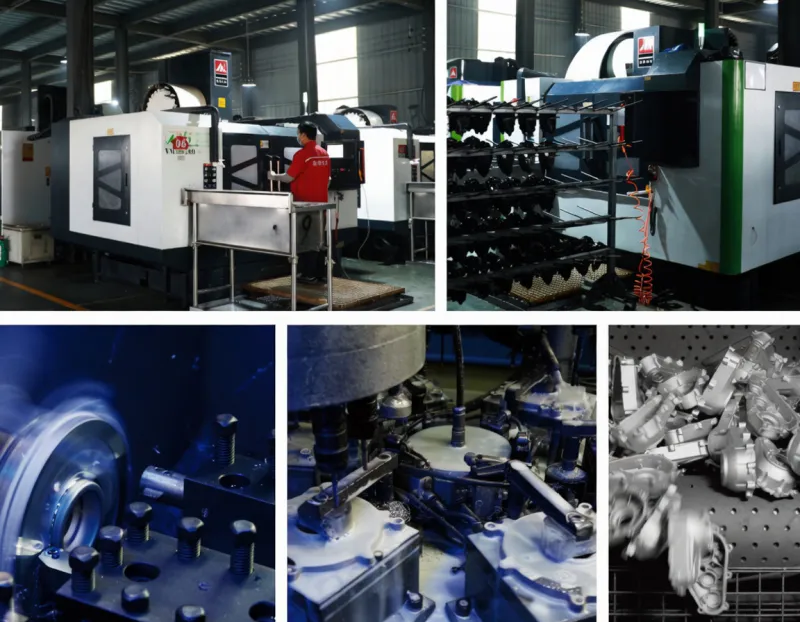
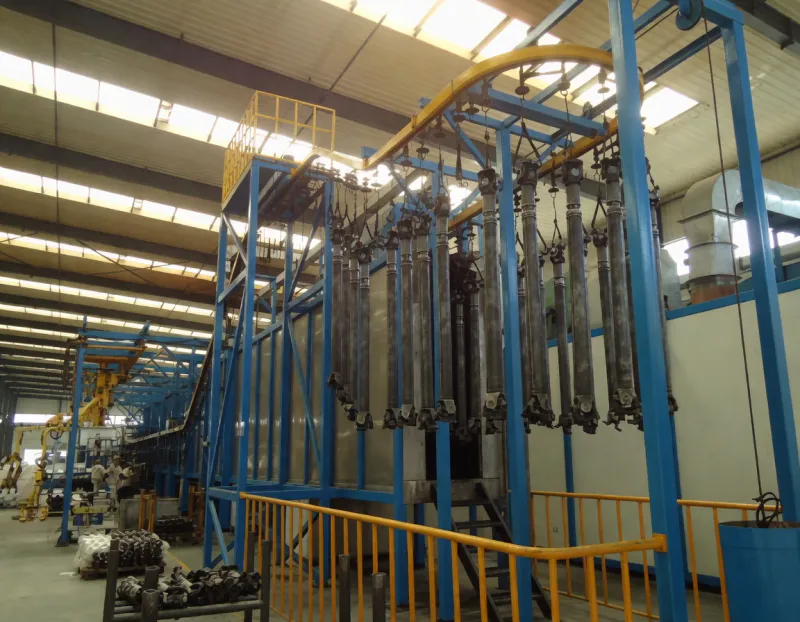
We are a specialized manufacturer of vehicle axle assemblies and drivetrain components, with deep production capability in front axle assemblies, rear axle assemblies, differential units, and matched driveline accessories. Our manufacturing footprint includes CNC gear cutting centers, carburizing and quenching heat treatment lines, gear grinding equipment, and dedicated assembly cells where each front axle differential assembly is built and bench-tested before packaging. The EP-1000 represents the production output of an established gear manufacturing supply chain — not a re-badged catalog import — which is why we publish the verified weight and dimension figures (5.1434 kg, 166 × 166 × 114 mm) rather than nominal values.
பட்டறை
9. Related Products — Complete Drivetrain System Supply
Beyond the EP-1000 front axle differential assembly, we manufacture the matched components needed to complete a full front and rear axle assembly. Sourcing from a single integrated supplier eliminates dimensional compatibility risk and consolidates procurement logistics for Colombian distributors and workshop chains:
Wheel Bolts
Wheel bolts complete the wheel hub interface that transfers driveline torque from the front axle differential assembly through the half-shafts and hub to the wheel rim. Our wheel bolts are produced from grade 10.9 alloy steel with rolled threads for fatigue strength, available in metric and imperial thread specifications matched to ATV, UTV, and light utility vehicle wheel hub standards. Specifying wheel bolts from the same manufacturer that supplied the differential assembly eliminates the risk of mismatched torque ratings across the wheel-end interface, ensuring that the bolt strength capacity matches the load-bearing capability of the differential and half-shaft components. View our complete Wheel Bolts range to specify the correct grade and thread for your application.
Trailer Axle Beam & Trailer Spindle
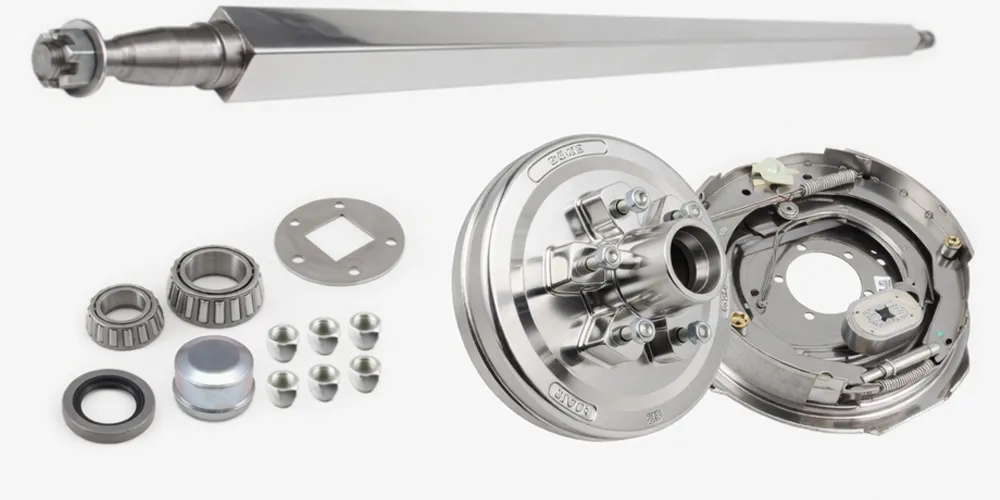
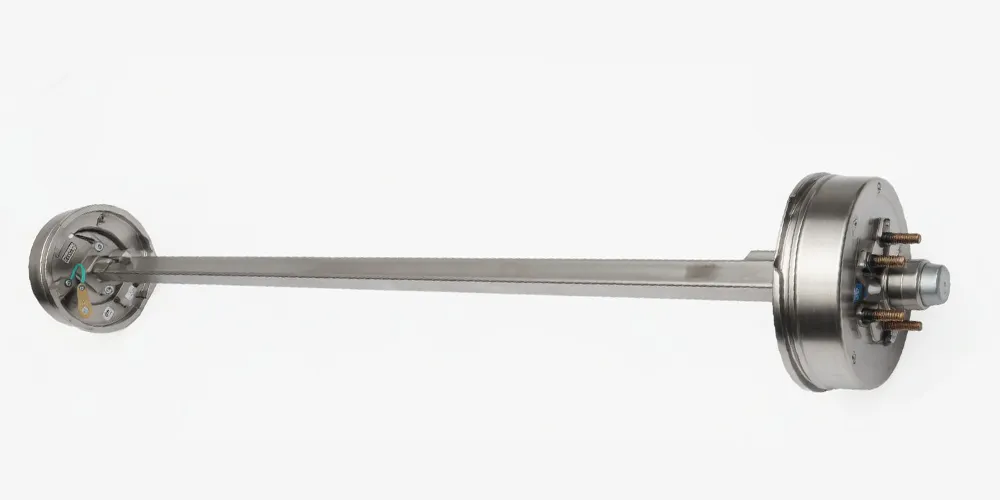
Trailer axle beams and trailer spindles complete the rolling-stock side of the drivetrain ecosystem, supporting unpowered trailer applications towed by 4×4 utility vehicles equipped with our front and rear axle differential systems. The trailer axle beam serves as the structural member of the trailer chassis, while the trailer spindle provides the wheel hub mounting interface. Both components are produced to match common ATV/UTV trailer designs, supporting Colombian agricultural and tourism operators who tow loads behind their utility vehicles. The combination of powered front axle differential, matched wheel bolts, and trailer axle components from a single supplier delivers a unified procurement and engineering experience.
அடிக்கடி கேட்கப்படும் கேள்விகள்
பதிப்பாசிரியர்: PXY