Penerangan
EP-Type B Bevel Gear — European Standard Series
Pressure Angle 20° | Ratio 1:3 | Material: C45 Steel | Bevel Gear Precision Engineering
1. Technical Parameters — Bevel Gear Type B, Ratio 1:3, Pressure Angle 20°, Material: C45
The table below lists the complete dimensional data for all module sizes in the EP-Type B series. All linear dimensions are in millimetres (mm). Scroll horizontally on mobile devices to view all columns.
| M | Z | De (mm) | Dp (mm) | A (mm) | F (mm) | Dn (mm) | D1 (mm) | dm (mm) | Da (mm) | L (mm) | Dm (mm) |
|---|---|---|---|---|---|---|---|---|---|---|---|
| 1 | 15 | 17.7 | 15.0 | 16.6 | 7.1 | 13.3 | 4 | 32 | 8 | — | 9.3 |
| 1 | 45 | 45.3 | 45.0 | 17.1 | 7.1 | 25.3 | 8 | 22 | — | — | 10 |
| 1.5 | 15 | 26.5 | 22.5 | 22.6 | 10.5 | 19.3 | 8 | 46 | 14 | — | 11.7 |
| 1.5 | 45 | 68.1 | 67.5 | 29.6 | 10.5 | 45.3 | 14 | 37 | — | — | 20 |
| 2 | 15 | 35.4 | 30.0 | 28.9 | 14 | 25.3 | 8 | 60 | 18 | — | 14.2 |
| 2 | 45 | 90.8 | 90.0 | 32.1 | 14 | 45.3 | 15 | 42 | — | — | 20 |
| 2.5 | 15 | 44.2 | 37.5 | 34.6 | 18 | 32.3 | 12 | 73 | 22.5 | — | 15.9 |
| 2.5 | 45 | 113.4 | 112.5 | 39.7 | 18 | 60.3 | 20 | 52 | — | — | 25 |
| 3 | 15 | 53.0 | 45.0 | 41.3 | 21 | 40.3 | 15 | 88 | 28.5 | — | 19.7 |
| 3 | 45 | 136.1 | 135.0 | 47.2 | 21 | 60.3 | 20 | 62 | — | — | 30 |
| 3.5 | 15 | 61.9 | 52.5 | 49.6 | 23.5 | 45.3 | 15 | 105 | 33.5 | — | 25.1 |
| 3.5 | 45 | 158.8 | 157.5 | 54.4 | 23.5 | 80.3 | 20 | 72 | — | — | 35 |
| 4 | 15 | 70.7 | 60.0 | 54.3 | 27.5 | 50.3 | 20 | 117 | 38 | — | 25.4 |
| 4 | 45 | 181.5 | 180.0 | 57.0 | 27.5 | 80.3 | 22 | 77 | — | — | 35 |
| 4.5 | 15 | 79.5 | 67.5 | 55.2 | 28.5 | 55.3 | 20 | 128 | 44 | — | 24.8 |
| 4.5 | 45 | 204.2 | 202.5 | 63.9 | 28.5 | 90.3 | 25 | 87 | — | — | 40 |
| 5 | 15 | 88.4 | 75.0 | 65.3 | 33 | 60.3 | 20 | 145 | 47 | — | 30 |
| 5 | 45 | 226.9 | 225.0 | 66.7 | 33 | 90.3 | 28 | 92 | — | — | 40 |
Column key — M: Module | Z: Number of Teeth | De: Outer Diameter | Dp: Pitch Diameter | A: Cone Distance | F: Face Width | Dn: Hub Diameter | D1: Bore Diameter | dm: Mounting Hole Circle | Da: Addendum Angle | L: Hub Length | Dm: Mean Pitch Diameter. All dimensions in mm.
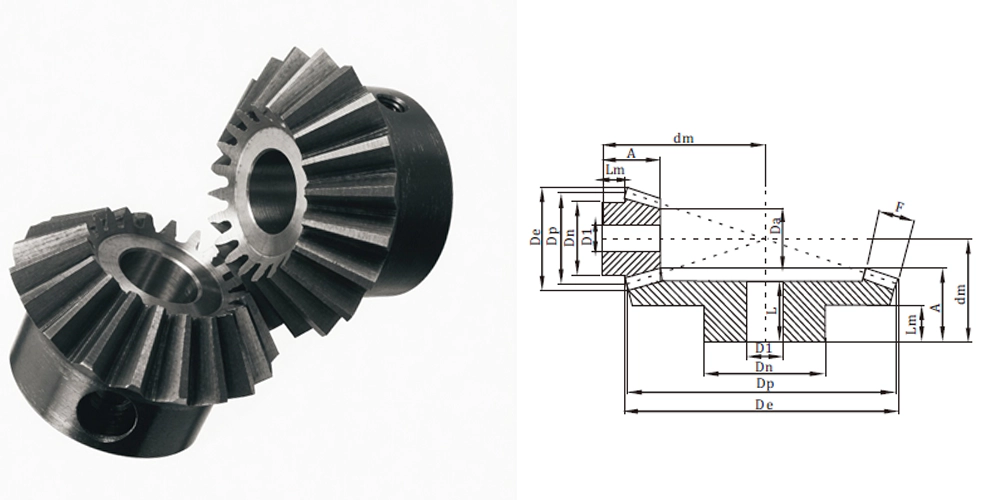
2. What Is a Bevel Gear? — Product Overview
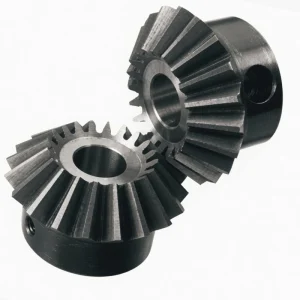
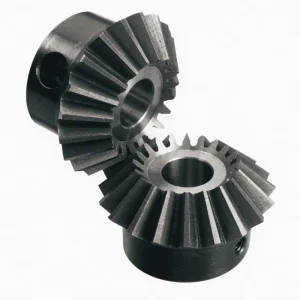
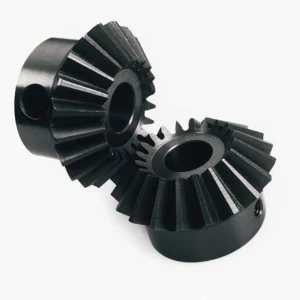
A bevel gear is a type of rotating mechanical component designed to transmit motion and torque between shafts that intersect — typically at a 90-degree angle, though other angles are also achievable depending on the application. The EP-Type B Bevel Gear from our European Standard Series is engineered for precise angular power transmission, featuring a pressure angle of 20° and a gear ratio of 1:3, which makes it ideally suited for applications requiring speed reduction with consistent torque multiplication. These metal bevel gears are machined from high-grade C45 carbon steel, ensuring they can withstand demanding load conditions and extended operational cycles without premature wear or failure.
The “Type B” designation within our EP series refers to the specific bore-and-key configuration of the hub geometry, allowing straightforward shaft integration for both drive pinions (Z=15 teeth) and driven wheels (Z=45 teeth). The European Standard (EP) series follows DIN and ISO dimensional guidelines, which means that these bevel gear sets are fully interchangeable with standard components used across European machinery platforms. For engineers, procurement specialists, and maintenance teams in Colombia, Latin America, the United States, and beyond, this compliance considerably reduces design validation time and makes replacement straightforward in the field.
Whether you are building new industrial machinery, retrofitting existing drive systems, or sourcing a reliable small metal bevel gear for a specialty automation project, this product line covers module sizes from M1 through M5 to meet a wide range of torque and space requirements. As a committed metal bevel gear manufacturer, we maintain full-run stock across all listed module sizes for rapid dispatch.
3. Five Key Advantages of EP-Type B Metal Bevel Gears
① Engineered 20° Pressure Angle for Maximum Load Capacity
The 20° pressure angle provides a superior balance between tooth strength and smooth meshing characteristics. Compared to older 14.5° designs, it allows higher torque transfer per module size, making it the preferred geometry for high power metal bevel gears in industrial drives. This geometry also reduces the risk of undercutting on smaller tooth counts, which is critical for pinions in the M1 to M2 range.
② European Standard (DIN/ISO) Compliance
Full conformity with European dimensional standards ensures seamless integration into existing drive trains, simplified spare-parts management, and ease of cross-referencing with international engineering drawings. For industrial operations in Colombia and across Latin America that import European OEM machinery, this compatibility eliminates costly custom adaptations and shortens maintenance downtime.
③ C45 Carbon Steel Construction for Durability
C45 medium-carbon steel offers an ideal combination of machinability, tensile strength (typically 600–750 MPa after normalising), and surface hardenability. These metal bevel gear parts can be further heat-treated — quenched and tempered or surface induction-hardened — to achieve case hardness suitable for continuous-duty cycles in manufacturing, agricultural, and construction equipment.
④ 1:3 Ratio for Efficient Speed Reduction
The fixed 1:3 transmission ratio (15-tooth pinion driving a 45-tooth wheel) delivers a reliable three-fold speed reduction in a single mesh stage, significantly reducing the need for additional reduction stages in compact drive assemblies. This ratio is widely applied in conveyors, mixers, and right-angle gearboxes where moderate torque multiplication and directional change must be achieved within a small envelope.
⑤ Complete Module Range (M1–M5) for Versatile Application
Covering module sizes from 1 to 5, this bevel gear set range caters to everything from light-duty instrumentation drives up to medium-heavy industrial gearboxes. Having a single-source supplier for all module variants simplifies procurement workflows, reduces vendor management overhead, and ensures consistent quality standards across your entire product line — a key advantage for OEM builders seeking a reliable custom bevel gears partner.
4. How Does a Metal Bevel Gear Work? — Operating Principle
Memahami how does metal bevel gear works begins with its fundamental geometry. Unlike spur or helical gears — which operate on parallel shafts — bevel gears are cut on conical blanks, so their tooth surfaces converge toward a common apex point. When two mating bevel gears share the same apex, their pitch cones roll together without slipping, producing a theoretically perfect rolling contact that transmits rotary motion with high efficiency and minimal noise.
In the EP-Type B configuration, the pinion (Z = 15 teeth) acts as the driver and the wheel (Z = 45 teeth) is the driven member. Because the tooth count ratio is exactly 1:3, for every single revolution of the pinion, the wheel completes one-third of a revolution — effectively tripling the available torque at the output shaft while reducing output speed to one-third of input speed. The 20-degree pressure angle geometry ensures that the normal force acting on tooth flanks is directed sufficiently away from the pitch line to generate thick, robust tooth roots, which is critical for sustained fatigue life under variable load conditions common in industrial drives.
Power enters through the pinion shaft, passes through the meshing zone where the conical tooth flanks of pinion and wheel engage in a rolling-sliding contact, and exits via the wheel shaft at a right angle (or at whatever shaft intersection angle has been designed into the housing). Correct bearing pre-load and precise axial positioning of both pinion and wheel are essential to maintaining optimum tooth contact pattern, which should be centrally located on the tooth flank under full-load conditions. Proper lubrication — either splash-oil in enclosed gearboxes or grease packing for open drives — is equally important to achieve rated service life.
5. Material Specification — C45 Carbon Steel
The EP-Type B Bevel Gear is manufactured from C45 medium-carbon steel, a material that occupies a well-established position in mechanical engineering as the go-to choice for gear, shaft, and coupling applications. C45 corresponds to SAE 1045 in North American standards and to EN 10083-2 in European norms, making it universally recognised by engineers across Colombia, the Americas, and Europe. Its nominal carbon content of approximately 0.45% provides a Brinell hardness of around 170–210 HB in the normalised condition, which offers a reliable foundation for tooth machining and subsequent heat treatment.
In service, C45 steel can be induction-hardened at the tooth surface to reach case hardness values of 52–58 HRC, substantially extending fatigue life and surface wear resistance without compromising the ductility of the core. This makes it particularly well suited to cyclic loading scenarios such as reversing drives, start-stop conveyors, and intermittent press drives. For applications where corrosion resistance is also required — for example, in food-processing or marine-adjacent environments — a zinc-phosphate conversion coating or galvanised plating can be applied without altering dimensional tolerances.
For customers requiring higher hardness throughout the cross-section, or where the operating environment involves prolonged exposure to moisture, we offer gear blanks produced from stainless steel bevel gears material (AISI 304 / AISI 316) or from case-hardening alloy steels such as 20CrMnTi upon request as part of our custom bevel gears programme. Contact us to discuss your specific material and heat-treatment requirements.
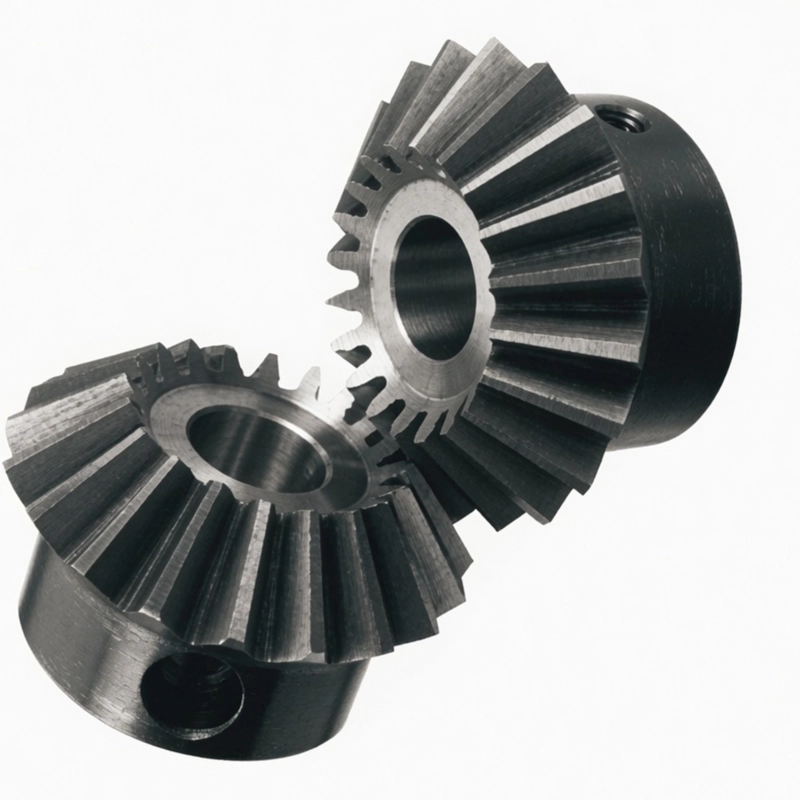
6. Metal Bevel Gear Applications — Where These Gears Deliver Results
The EP-Type B metal bevel gear set finds productive service across a broad spectrum of industries. Below are some of the primary metal bevel gear application areas where this component consistently delivers dependable performance.
Industrial Gearboxes & Conveyors
Right-angle gearboxes are the most common home for bevel gears in heavy industry. In Colombia’s growing mining and aggregate-processing sectors, conveyor systems regularly rely on bevel gear sets to redirect belt drive power through 90 degrees while simultaneously stepping down motor speed to the required belt speed. The M3–M5 range within this series handles the torque loads typical of medium-capacity belt conveyors without requiring oversized housings.
Agricultural Machinery
Colombian agriculture relies heavily on mechanised equipment for sugar cane, coffee, and fresh-produce operations. Bevel gear drives are integral to rotary tillage equipment, seed drills, hay balers, and power take-off (PTO) assemblies. The C45 construction provides the toughness needed for field conditions where shock loads and vibration are frequent, and the M2–M4 module sizes match the torque envelopes of common PTO-driven implements.
Printing & Packaging Equipment
High-speed printing presses and packaging lines demand precisely ground gears that run smoothly and quietly. The M1 and M1.5 module sizes within this series, with their tight dimensional tolerances, are regularly specified for feed-roller drives, impression cylinder gearing, and inkjet carriage drives. Smooth meshing at the 20° pressure angle reduces vibration-induced print-quality defects and minimises noise in operator environments.
Automation & Robotics
As Colombian manufacturing facilities increase their automation investment, the demand for compact, reliable angular transmission components in robot arm joints, pick-and-place gantries, and CNC rotary tables continues to grow. Mini metal bevel gears in the M1 and M1.5 range fit within tight joint envelopes while still providing the stiffness needed for positioning accuracy. The fixed 1:3 ratio is a common choice for wrist or elbow joints in Cartesian robots.
Marine & Construction Equipment
Winches, deck cranes, and hydraulic pump drives on inland waterway vessels along Colombia’s Magdalena River commonly incorporate bevel gear stages. Similarly, road-construction equipment such as motor graders and concrete mixers use bevel gear pairs in their final-drive assemblies. Heavier modules (M4–M5) in this series are sized for these demanding applications, where operational availability in remote locations makes component reliability paramount.
RC Models & Hobbyist Drives
Yang metal bevel gear for RC car segment is a fast-growing niche, driven by hobbyists who upgrade plastic drivetrain components for improved durability and performance. Small metal bevel gears in M1 module are a direct fit for many 1/8 and 1/10 scale RC crawlers, buggies, and truggies. Metal construction dramatically reduces differential gear failure rates under aggressive off-road use, making this a popular upgrade item in the RC community worldwide.
7. Regulatory Compliance — Gear Products in Colombia and Internationally
Industrial gear components, including bevel gear sets used in machinery, are subject to a range of safety, quality, and import regulations that vary by end-use application and destination market. Below is a summary of the principal frameworks relevant to buyers in Colombia and other key regions.
Colombia (ICONTEC / INVIMA / DIAN): In Colombia, mechanical transmission components fall under the technical oversight of ICONTEC (Instituto Colombiano de Normas Técnicas y Certificación). Machinery incorporating these bevel gear drives may require conformity evaluation under NTC standards aligned with ISO 6336 (gear-tooth strength calculations) and ISO 1328 (gear accuracy). Import duties on precision mechanical parts are governed by Colombia’s Arancel de Aduanas, and buyers should verify applicable HS tariff codes — typically under Chapter 84 of the Harmonised System — before procuring. DIAN (Dirección de Impuestos y Aduanas Nacionales) administers customs clearance, and importers must ensure that commercial invoices and packing lists accurately reflect the HS code and declared value.
European Union (CE / Machinery Directive 2006/42/EC): Equipment incorporating these bevel gear drives and sold in EU member states must comply with the EU Machinery Directive (transitioning to EU Machinery Regulation 2023/1230 effective January 2027). The gear components themselves are not CE-marked individually, but the assembled machinery must meet Essential Health and Safety Requirements (EHSRs), with EN ISO 4156, ISO 6336, and EN ISO 12100 among the relevant harmonised standards for gear safety and machine risk assessment.
United States (AGMA / ANSI): North American engineering practice follows AGMA (American Gear Manufacturers Association) standards. AGMA 2003-C10 governs rating of bevel gears for pitting resistance and bending strength. While AGMA standards differ in detail from ISO 6336, the underlying engineering principles are compatible, and our EP-Type B gears can be evaluated under AGMA methodology by qualified gear engineers.
Other Regions: In Mexico, NOM standards administered by SE (Secretaría de Economía) apply to machinery safety. Brazil follows ABNT (Associação Brasileira de Normas Técnicas) NBR standards for mechanical components. In China, GB/T standards govern gear manufacturing and inspection. For food-processing applications anywhere in the world, FDA and EC 1935/2004 materials regulations may apply when gears operate in zones where incidental contact with food products is possible — in such cases, a food-grade lubricant and appropriate surface treatment should be specified.
8. Tentang Kami
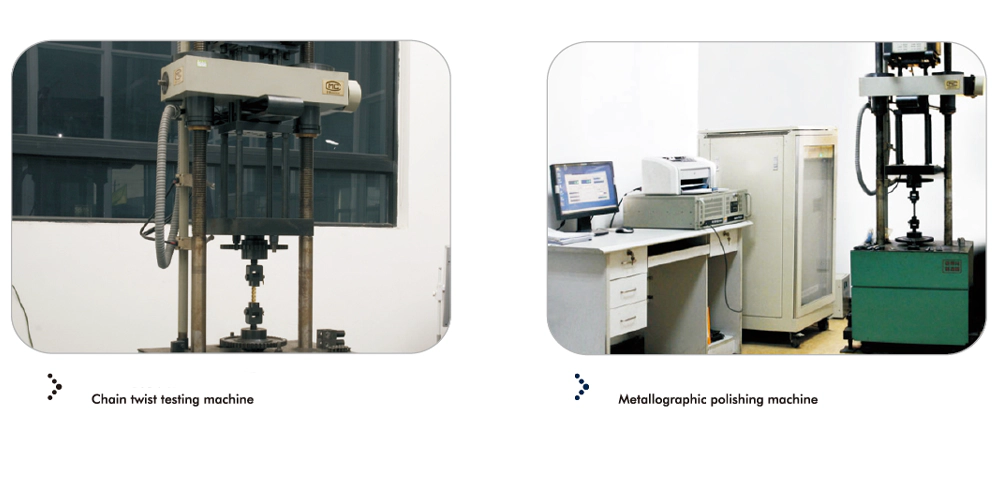
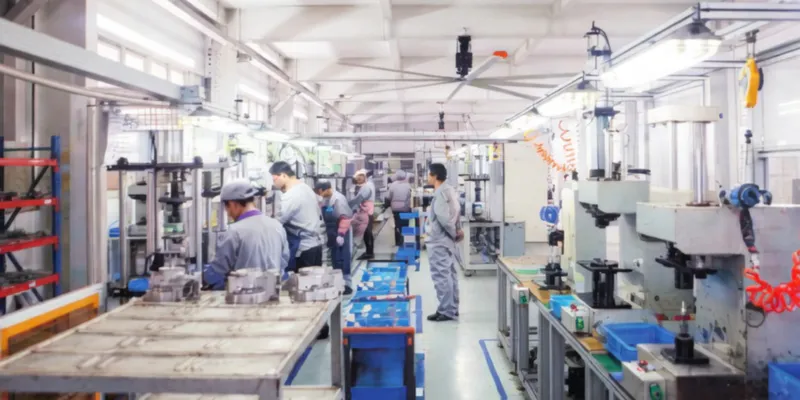
We are a specialised manufacturer and global supplier of mechanical power transmission components, with a product portfolio spanning gears, sprockets, chains, and associated drive accessories. With decades of accumulated engineering expertise, our production facilities operate to ISO 9001 quality management standards, and our technical team maintains active involvement in international gear standardisation bodies. From mini metal bevel gears for precision instruments to heavy metal bevel gears for industrial gearboxes, our manufacturing programme covers the full spectrum of torque and size requirements.
Kedai Kerja
9. Related Products — Complete Drive System Solutions
A bevel gear performs at its best when paired with compatible drive components. We supply a full range of transmission accessories designed to work in harmony with our metal bevel gear types and sizes. Below are two key product families that complement the EP-Type B series and allow you to build a complete, sourcing-simplified drivetrain from a single supplier.
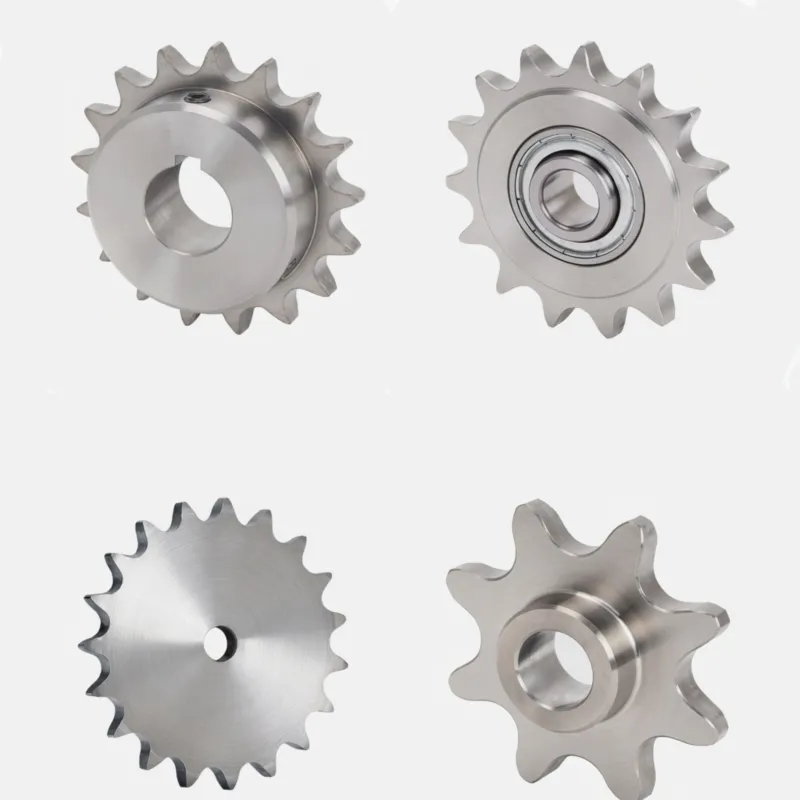
Sprockets
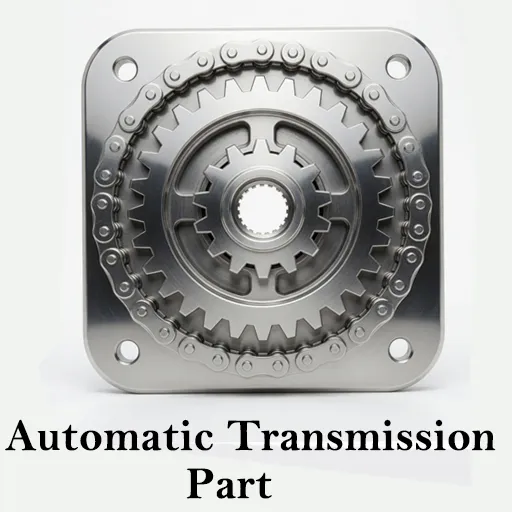
Our sprocket range covers simplex, duplex, and triplex configurations in standard ANSI and ISO chain pitches. When your bevel gear output shaft feeds a chain drive stage, selecting a matched sprocket from the same supplier ensures dimensional compatibility, consistent material quality, and streamlined procurement. Combining our bevel gears with our sprockets gives you a fully integrated right-angle-plus-chain reduction solution.
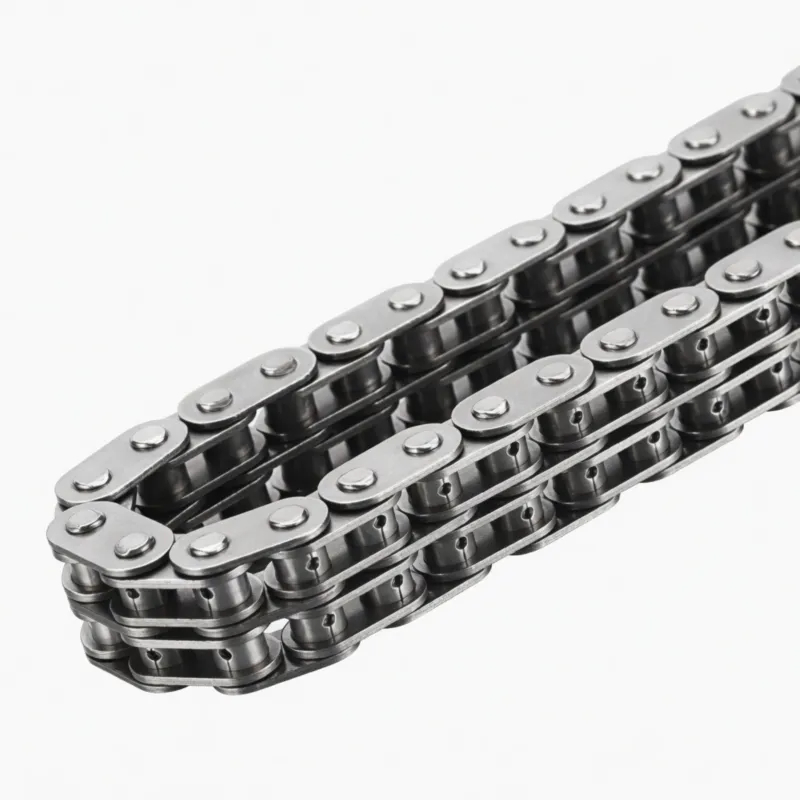
Rantai Penggelek
Paired with our sprockets, our roller chain selection covers ANSI 25 through ANSI 240 and equivalent ISO/DIN sizes, including stainless-steel and nickel-plated variants for corrosive environments. Using our roller chain alongside our bevel gear drives and sprockets eliminates the guesswork around inter-component compatibility and reduces the risk of premature chain wear caused by sprocket pitch mismatch. Our one-stop supply model means your engineering team can specify, order, and receive your complete drivetrain components in a single transaction.
Frequently Asked Questions — Bevel Gear
Q1. What is a bevel gear and how is it different from a standard spur gear?
▼
A bevel gear is a cone-shaped gear used to transmit rotary motion between shafts that meet at an angle — most commonly 90 degrees. Unlike a spur gear, which operates on parallel shafts and has straight teeth cut perpendicular to the rotation axis, a bevel gear’s teeth are cut on a conical surface, allowing the pitch cones of two mating gears to roll together without slip. This makes bevel gears the preferred solution wherever direction change and speed reduction must be achieved simultaneously in a compact assembly.
Q2. Which metal bevel gear types are best suited for high-torque industrial conveyor drives in Colombia?
▼
For high-torque conveyor drives, straight bevel gears in C45 steel — such as the M4 and M5 variants in this EP-Type B series — offer the best combination of load capacity, machinability, and availability. If noise reduction is a priority in the application environment, spiral bevel gears provide smoother engagement but require more precise mounting. For most industrial conveyor applications in Colombian mining or food-processing facilities, the straight-tooth M4–M5 range delivers sufficient torque capacity with simpler installation requirements.
Q3. Why choose a metal bevel gear over a plastic or nylon gear for my automation project?
▼
Metal bevel gears — particularly those machined from C45 carbon steel — offer significantly higher torque capacity, dimensional stability under thermal cycling, and longer service life compared with plastic or nylon alternatives. While plastic gears are adequate for low-load, low-speed applications where quietness is the overriding priority, any automation system carrying meaningful torque, operating at elevated temperatures, or requiring long-term positional accuracy will benefit from the stiffness, hardness, and fatigue strength that only metal construction can provide.
Q4. Where can I find a reliable bevel gear supplier in Colombia or Latin America for ongoing industrial MRO?
▼
We supply bevel gear components directly to industrial end users and MRO distributors throughout Colombia, including major industrial centres such as Bogotá, Medellín, Barranquilla, and Cali, as well as to customers across the broader Andean region. Our export logistics handle international customs documentation, and we can provide material certificates, dimensional inspection reports, and export packing as required by Colombian importers. Contact us to discuss standing-order arrangements that reduce lead times and administrative overhead for recurring MRO procurement.
Q5. What is the best lubrication approach for a bevel gear set running in an open agricultural drive?
▼
For open-drive agricultural applications, an ISO VG 220 or VG 320 gear grease is the standard recommendation. Grease should be packed into the tooth mesh zone and reapplied at regular service intervals — typically every 200–500 operating hours depending on exposure to dust, moisture, and ambient temperature extremes common in Colombian field conditions. Enclosed gearboxes use splash-bath lubrication with an ISO VG 220 mineral gear oil, changed at first service after 200 hours and thereafter at annual intervals or per the gearbox OEM’s recommendation.
Q6. When should I choose a 1:3 gear ratio versus a 1:2 or 1:4 ratio for a right-angle drive gearbox?
▼
A 1:3 ratio is a balanced choice when you need meaningful speed reduction and torque multiplication in a single mesh stage without resorting to a bulky multi-stage gearbox. It keeps the diameter difference between pinion and wheel moderate, which helps maintain compact housing geometry. Choose 1:2 when you need minimal speed reduction and maximum power density. Choose 1:4 when the application demands a higher reduction ratio than 1:3 can deliver in one stage. For very high ratios (above 1:5), a worm gear or a multi-stage bevel arrangement is more practical than a single bevel pair.
Q7. How do I correctly install a small metal bevel gear to ensure proper tooth contact and avoid premature wear?
▼
Correct bevel gear installation requires precise axial positioning of both pinion and wheel so that their pitch-cone apices coincide at the theoretical intersection point. Use shim adjustments behind the bearing housings to achieve the correct mounting distance (dimension A in our table). After assembly, check the tooth contact pattern using marking compound: the contact area should be centred on the tooth flank and cover approximately 50–70% of the tooth length under load. Avoid backlash settings that are too tight — a small amount of backlash is necessary to prevent binding under thermal expansion and lubricant film build-up.
Q8. What heavy metal bevel gear options are available for Colombian mining and quarrying equipment applications?
▼
For heavy-duty mining and quarrying applications — such as crusher drives, ball mill pinions, and slurry pump gearboxes — we recommend the M4 and M5 variants within this EP-Type B series for moderate torque requirements. For very high-torque applications exceeding what standard module sizes can handle, our engineering team can develop custom bevel gears in alloy steel (e.g., 42CrMo4 or 18CrNiMo7-6) with case-hardened and ground tooth flanks to ISO accuracy grade 5 or better. Please contact us with your torque, speed, and space-envelope data so we can recommend the optimal solution.
Q9. Which bevel gear metal types and surface treatments work best in high-humidity Colombian coastal environments?
▼
In the high-humidity coastal environments of Barranquilla, Cartagena, and the Colombian Caribbean coast, standard C45 steel gears benefit significantly from a zinc-phosphate conversion coating with oil impregnation, or from an electroless nickel plating for moderate corrosion exposure. Where exposure is more severe or the gear operates in a chemically aggressive environment, stainless steel bevel gears (AISI 316) are the recommended choice. These maintain adequate mechanical properties while providing substantially improved corrosion resistance, and they are available as custom-order items from our production programme.
Editor: PXY